How to Calculate and Track Your Net Worth in India With a Free App

Tracking net worth helps people understand their actual financial position by comparing what they own against what they owe. In India, managing savings, investments, loans, EMIs, property, and digital assets across multiple platforms often makes wealth tracking difficult without a structured system.
Using a net worth tracking app helps organise assets and liabilities in one place and improves overall financial visibility.
In this guide, you will learn:
- How to calculate net worth
- The net worth formula explained simply
- How to build an assets and liabilities list
- How to track net worth regularly
- How Net Worth Tracking Improves Wealth Management
- How AI-powered tools simplify personal finance tracking
What is Net Worth?
Net worth is the total value of your assets minus your liabilities.
In simple terms:
- Assets are things you own
- Liabilities are things you owe
Net worth gives a clearer financial picture than salary alone because it measures overall financial health.

What is the Net Worth Formula?
The basic net worth formula is:
Net Worth = Total Assets − Total Liabilities
What Should Be Included in Net Worth?
The assets and liabilities list is important for net worth tracking.
- Assets usually include savings, investments, gold, EPF balances, property, vehicles, and emergency funds.
- Liabilities include home loans, personal loans, education loans, EMIs, and credit card dues.
Know the detailed difference between assets and liabilities.
Track Net Worth Online Instead of Using Spreadsheets
Many people start tracking net worth through spreadsheets.
But once investments, loans, savings accounts, PPF/ EPF balances, and expenses get spread across multiple platforms, updating everything manually becomes difficult.
Explore the detailed difference between PPF and EPF.
This is why many people now prefer using a net worth tracking app to organise assets, liabilities, and investments in one place.
jUMPP , an easy-to-use, free wealth management app in India, helps simplify net worth tracking by organising financial information, analysing spending behaviour, and improving financial visibility.
jUMPP AI helps simplify net worth tracking through AI-powered financial insights and automated wealth visibility.
jAI stands for jUMPP Artificial Intelligence. It works as a smart finance assistant that helps users:
- Track personal net worth
- Monitor assets and liabilities
- Analyse spending patterns
- Organise financial data
- Improve budgeting visibility
- Track wealth growth over time
How to Track Net Worth with jAI
Step 1: Tap on FinSights from the top menu.
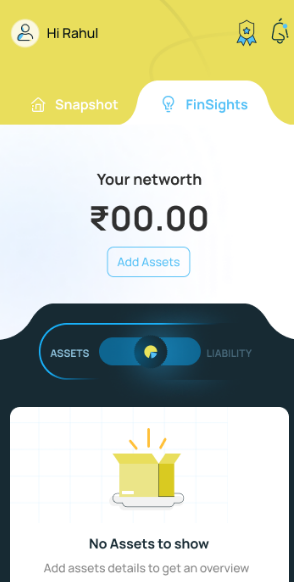
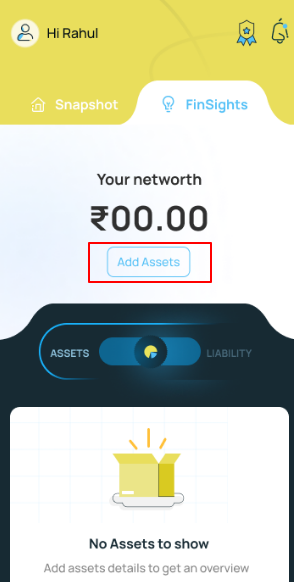
Step 2: Tap on “Add Assets” to start linking your accounts.
Step 3: Enter the OTP sent to your registered mobile number to continue.

Step 4: You will see a message displayed on your screen confirming that your account has been added successfully.

Step 5: Link your savings account.

Step 6: Now, swipe the toggle button to the right to add your liabilities.

Step 7: Check the various categories displayed on your screen and enter the respective details for personal loans, vehicle loans, home loans, and more.
Step 8: As soon as your details are added, you can view your net worth on your screen

Watch: How to Track Your Net Worth Using jAI by jUMPP
Now that you understand the steps, see how you can calculate and track your net worth instantly in one place.
Why Is Net Worth Tracking Important?
Net worth tracking helps measure whether financial progress is actually improving over time.
- Income alone does not show real financial health
Many people in India earn well but still feel financially stressed because EMIs, loans, subscriptions, and lifestyle expenses quietly increase every year. Net worth tracking shows whether wealth is actually growing or just income.
- It helps people see where they truly stand financially
Checking salary credits or investment returns separately does not give the full picture. Net worth combines assets and liabilities together so people understand their actual financial position clearly.
- Debt becomes easier to understand
Home loans, personal loans, credit card dues, and car EMIs often feel manageable individually. But when seen together, many people realise how much debt is affecting long-term wealth growth.
- Financial goals start feeling more realistic
Goals like buying a house, building emergency savings, funding children’s education, or retiring comfortably require long-term planning. Tracking net worth helps measure whether current financial habits support those goals.
- It improves spending awareness naturally
People often spend differently once they understand their overall financial position. Frequent online shopping, convenience spending, or unnecessary upgrades become easier to notice when wealth tracking is reviewed regularly.
- Investments make more sense when tracked together
Many Indians invest across multiple platforms through SIPs, stocks, EPF, gold, and savings accounts. Net worth tracking helps organise everything in one place instead of checking accounts separately.
Check out the tax saving investment options for 2026!
- Lifestyle inflation becomes easier to control
As income increases, spending usually increases too. Better phones, frequent dining out, subscriptions, and impulse purchases slowly become normal expenses. Net worth tracking helps people identify whether wealth is growing faster than lifestyle costs.
Net Worth Tracking – FAQs
You can track your net worth by listing your total assets and subtracting your total liabilities. Many people now use a net worth tracking app to organise savings, investments, loans, and expenses in one place.
Tracking net worth online in India is easy with platforms that help consolidate bank accounts, investments, loans, and liabilities together for better financial visibility. You can do it through a free net worth tracking app in India.
In a balance sheet, net worth is calculated by subtracting total liabilities from total assets. This formula is commonly used for both personal finance and business financial analysis.
A net worth calculator helps estimate financial health by calculating the difference between total assets and total liabilities.
A company’s net worth is calculated by subtracting total liabilities from total assets listed on the balance sheet. This is also known as shareholder equity or owner’s equity.
The 7-3-2 rule is a long-term investing concept suggesting investments may double approximately every 7 years at 10% returns, triple in around 21 years, and continue compounding over time.
A ₹10 crore net worth is generally considered financially strong in India, especially when supported by diversified assets, low liabilities, and stable long-term financial planning.
A person’s exact net worth usually cannot be verified publicly unless financial disclosures, company filings, or public business ownership records are available. Online estimates are often approximate and unofficial.