How AI Analyses Spending Data and What It Says About Your Money Habits
What if your bank statement could describe your personality?
In many ways, it already does.
The places where you spend, the timing of your purchases, and the categories that consume most of your income can reveal surprisingly accurate insights about your habits and decision-making patterns. Artificial intelligence is increasingly using this information to generate personalised financial recommendations and help people understand their relationship with money.
Understanding how AI analyses spending data can help you uncover hidden spending patterns, recognise your financial behaviours, and make better money decisions.
Let us see how it works.
What is AI Spending Analysis?
AI spending analysis refers to the use of artificial intelligence to automatically analyse, categorise, monitor, and optimise spending patterns by processing financial data and identifying meaningful insights.
It can answer questions such as:
- How consistently do you save money?
- Which categories consume most of your income?
- Are your spending habits changing over time?
- What triggers your impulsive purchases?
- How financially resilient are you during emergencies?
How AI Analyses Spending Data?
Artificial intelligence analyses spending data by collecting and processing transaction information from bank accounts, cards, and digital payments. It then uses machine learning algorithms to categorise expenses, identify recurring spending patterns, detect unusual transactions, and predict future spending trends.
Whenever you make a purchase, data points such as the following are created:
- Transaction amount
- Merchant category
- Purchase frequency
- Date and time of purchase
- Payment method
- Geographic location
- Income and expenditure trends
AI spending analysis combines these variables to identify behavioural patterns.
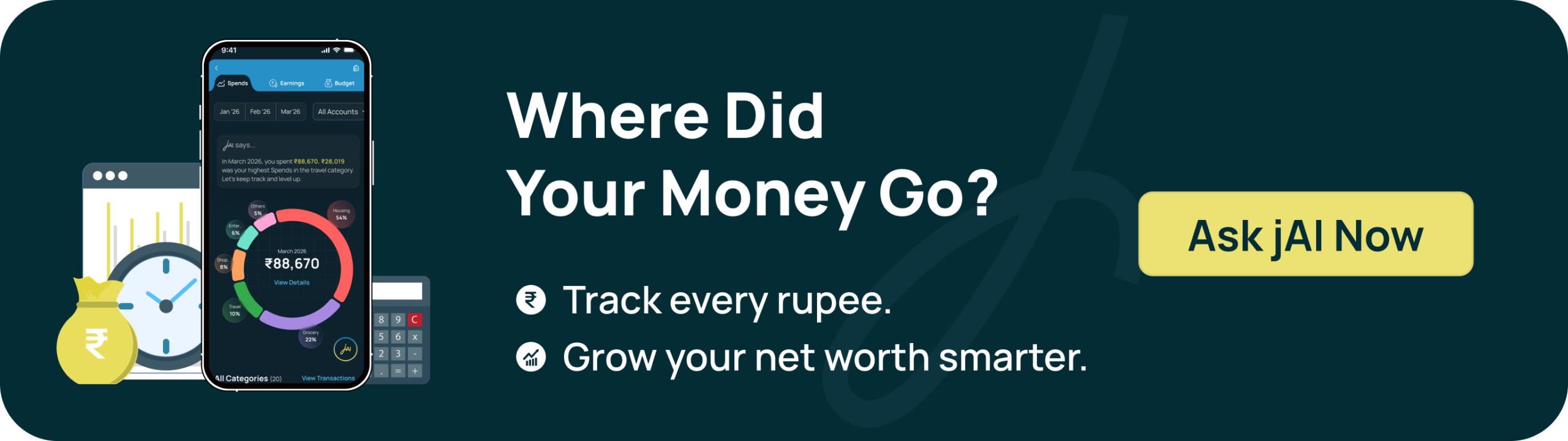
Understanding spending habits using AI helps people keep a check on their monthly savings. See how you can track your monthly spending and check your net worth with AI.
How AI Analyses Spending Habits?
The process of AI analysing spending habits generally involves the following stages:
- Data Collection and Processing
AI gathers transaction information such as purchase amounts, merchant details, payment methods, and transaction dates from various financial sources.
- Expense Categorisation
Machine learning models automatically classify transactions into categories such as groceries, entertainment, travel, or utility bills.
- Pattern Recognition
AI identifies recurring expenses, spending habits, and behavioural trends that may not be immediately obvious to users.
- Anomaly Detection
Algorithms can flag unusual spending spikes, duplicate transactions, or potentially fraudulent activities by comparing transactions against established spending patterns.
- Trend Analysis and Personalised Insights
By analysing historical spending behaviour, AI can identify changes in financial habits, predict future expenses, and generate personalised recommendations to support better budgeting and financial planning.
What Your Spending Habits Say About You
Your spending decisions often reflect your priorities, emotions, and financial mindset.
- Frequent Dining Expenses
High spending on restaurants and food delivery services may indicate convenience-driven behaviour or a demanding work schedule.
- Regular Investments and Savings
Consistent contributions towards investments often reflect long-term financial planning and disciplined money management.
- Impulse Purchases
Frequent discretionary spending may indicate emotional buying patterns and reduced spending control.
- Heavy Subscription Spending
Numerous subscriptions may reveal convenience preferences but could also indicate inefficient expense management.
- Travel and Lifestyle Spending
High expenditure on experiences often suggests value-driven spending focused on lifestyle and personal fulfilment.
This form of AI money behaviour analysis enables individuals to understand not only where their money goes but also why they spend the way they do.
Want a deeper understanding of how your spending behavior shapes your financial future? Explore our guide on AI money habits analysis to discover how artificial intelligence identifies spending patterns, behavioral triggers, and opportunities to build healthier financial habits.
How Spending Pattern Analysis Apps Generate Personal Finance Insights
Spending pattern analysis apps generate actionable financial insights by pulling transaction data, classifying it, and running it through algorithms. They transform raw numbers into personalised behavioural maps
These AI-powered personal spending insights help users understand recurring expenses, identify inefficient spending habits, and make more informed financial decisions.
Modern applications use machine learning algorithms to:
- Categorise expenses automatically
- Detect changes in spending behaviour
- Predict future expenses
- Identify unnecessary subscriptions
- Recommend savings opportunities
- Generate personalised financial reports
For example, if an application identifies that your utility expenses rise during certain months every year, it may recommend setting aside additional funds in advance.
How jAI Turns Spending Data Into Personalised Insights
This AI expense tracker goes beyond simply tracking transactions by analysing spending data and transforming it into meaningful, actionable insights.
jAI is a conversational finance buddy that helps track expenses, create personalised budgets, set spending limits, and make smarter money decisions with AI-powered insights.
With jAI, users can:
- Automatically classify expenses into meaningful spending categories
- Identify recurring expenses and subscriptions that may be affecting savings
- Recognise changes in spending patterns and financial behaviours over time
- Receive personalised insights based on transaction history and spending habits
- Discover opportunities to budget, save, and make informed financial decisions
- Track expenses through secure bank account connectivity instead of relying solely on SMS-based transaction tracking
- Gain a more accurate and real-time view of their overall financial position and net worth
- Use Private Mode, ensuring that financial data remains on the user’s device and is not sent outside the phone
- Benefit from strong data encryption and privacy safeguards designed to protect sensitive financial information
- Rely on security standards backed by ISO 27001:2022 certification and PCI DSS compliance.
What are the Benefits of AI Expense Tracking and Financial Behaviour Analysis
AI-powered financial analysis offers several advantages.
- Improved Financial Awareness
Users gain a deeper understanding of their spending habits and financial behaviour.
- Personalised Recommendations
AI provides tailored suggestions instead of generic financial advice.
- Early Identification of Risky Habits
Unhealthy spending trends can be identified before they create serious financial problems.
- Better Budgeting Decisions
AI-driven insights help users allocate money more efficiently.
- Goal-Based Financial Planning
Financial recommendations can be aligned with individual goals such as saving, investing, or debt reduction.
The growing use of data-driven personal finance insights is making financial management increasingly personalised and proactive.
Looking for personalized guidance beyond expense tracking? Learn how an AI financial advisor can analyze your financial behavior, provide tailored recommendations, and help you make smarter budgeting, saving, and investment decisions.
What are the Limitations of AI Spending Analysis
Although AI has significantly improved financial management, it is not without limitations.
- Dependence on Data Quality
Incorrect or incomplete transaction data can generate inaccurate recommendations.
- Privacy Concerns
Financial data is highly sensitive, and users must understand how their information is collected and stored.
- Limited Emotional Context
AI can identify patterns but may not fully understand the personal circumstances behind every spending decision.
- Potential Biases
Algorithms trained on incomplete datasets may occasionally produce misleading insights.
Therefore, AI spending analysis should complement human judgment rather than replace it entirely.
Conclusion
Through AI expense tracking analysis, behavioural finance models, and personalised recommendations, technology is helping individuals make smarter financial decisions based on their unique spending patterns.
Ultimately, understanding what your spending habits say about you is about gaining awareness. And when combined with data-driven personal finance insights, that awareness can become one of the most powerful tools for building better financial habits and achieving long-term financial well-being.
Also read: How AI in banking is making tasks easier for banks as well as the customers.
FAQs
Yes, ChatGPT can analyse structured data, identify patterns, summarise information, and generate insights. However, important decisions should still involve human review and verification.
The four types of data analysis are descriptive, diagnostic, predictive, and prescriptive analysis. They explain what happened, why it happened, what may happen next, and what actions should be taken.
The four types of AI are Reactive Machines, Limited Memory AI, Theory of Mind AI, and Self-Aware AI. Most modern AI applications currently fall under the Limited Memory category.
The seven types of AI include Reactive Machines, Limited Memory AI, Theory of Mind AI, Self-Aware AI, Artificial Narrow Intelligence (ANI), Artificial General Intelligence (AGI), and Artificial Superintelligence (ASI).
The 30% rule for AI suggests that around 30% of a workflow can be automated using AI, while the remaining tasks require human oversight and decision-making. The principle promotes responsible use of AI and reduces the risk of errors from over-automation.
Yes, several AI tools, including ChatGPT, Google Gemini, Microsoft Copilot, and Tableau AI, can analyse data. They can identify patterns, generate reports, and provide actionable insights from large datasets.