Self-Attested Meaning: Steps to Verify Aadhaar Card, Photos & Documents
From Aadhaar card submissions to passport forms, self-attestation has become a common requirement in India. Whether you are applying for a job, opening a bank account, or submitting academic documents, knowing how to self-attest documents correctly can help you avoid unnecessary rejection or delays.
What is Self-Attestation?
Self-attestation is the process of verifying your own documents by signing them yourself instead of getting them verified by a notary or gazetted officer.
Self Attested Meaning
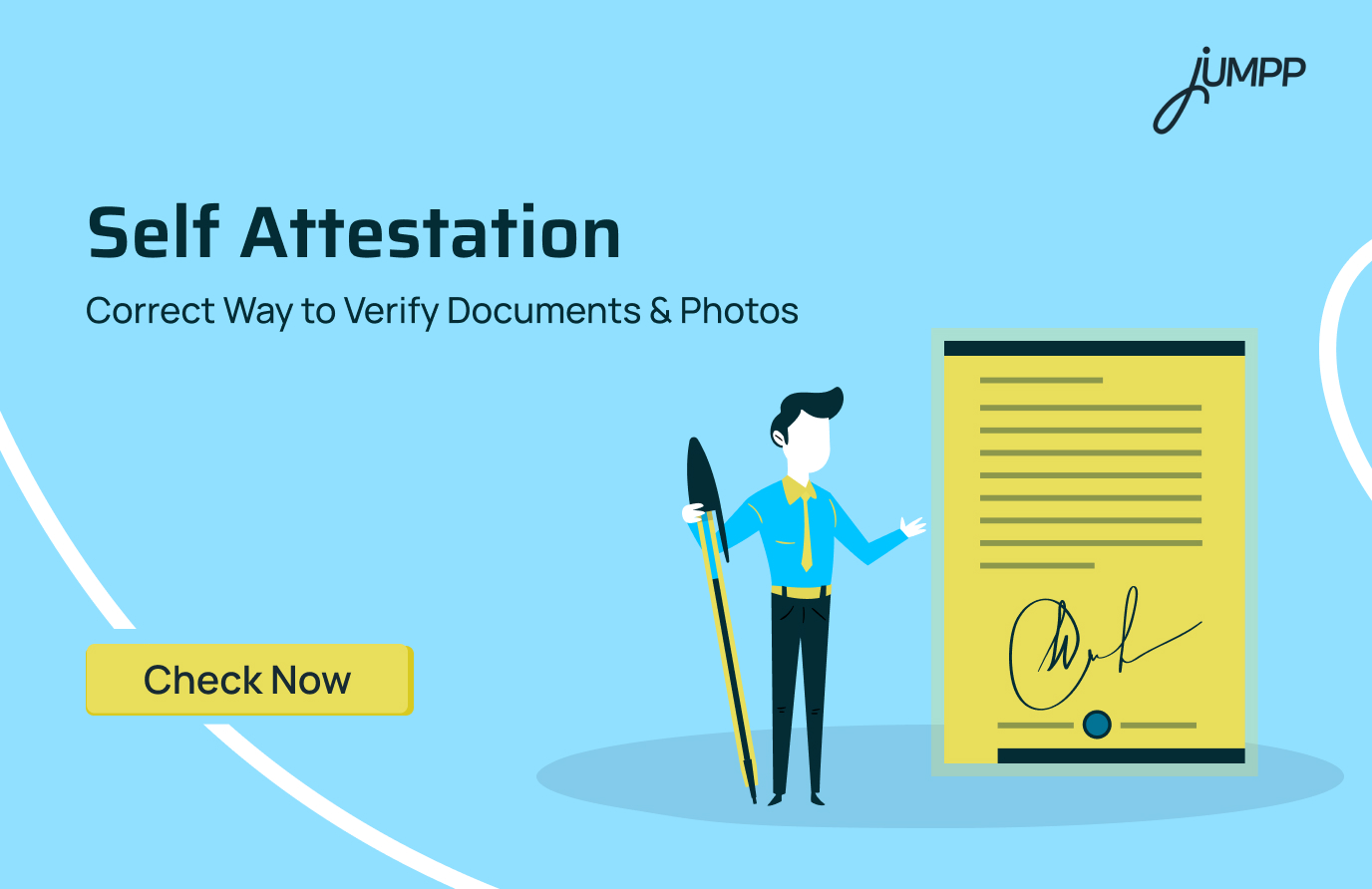
“Self attested” means you verify a document yourself by signing it, confirming that the photocopy is a true copy of the original document.
It is commonly required for:
- Bank KYC
- Job applications
- College admissions
- Government forms, etc.
What is the difference between self-attested and notarised?
The main difference is who verifies the document. In self-attestation, you sign the document yourself to confirm it is a true copy. In notarization, a licensed Notary Public verifies your identity and witnesses the signature officially.
- Self-attested = signed by you
- Notarised/attested = verified by a notary or gazetted officer
What is a Self-Attested Photo?
A self-attested photo is a passport-size photograph signed by the person submitting it.
Usually, you need to sign on the front or back of the photo to confirm that the photograph belongs to you.
It is commonly required for:
- Government forms
- College admissions
- Job applications
- Passport or visa documents
What is a Self-Attested Document?
A self-attested document is a photocopy of an original document that you sign yourself to confirm it is a true copy of the original.
For example:
- Aadhaar card copy
- PAN card copy
- Marksheet copy
- Passport copy, etc.
You usually write:
- “Self-attested”
or - “True copy of the original”
And then add your signature and date.
How to Self-Attest a Document?
To self-attest a document, you need to take a clear photocopy of your original document and write “Self-Attested” or “True Copy” in an empty space. Then sign your name exactly as it appears on your official documents and add the current date below the signature.
Here are the simple steps that you must follow to self-attest any document –
Step 1: Take a clear photocopy of the original document you need to submit.
This could be your Aadhaar card, PAN card, marksheet, passport, or any other required document.
Step 2: Write a short note on the photocopy.
You can simply write:
- “Self-attested”
- “True copy of the original”
- “Self-attested true copy”
Step 3: Sign below the statement.
Use the same signature you normally use on official documents.
Step 4: Add the date below or beside your signature.
For example: 26/05/2026
Step 5: If the document has more than one page, make sure you sign each page separately.
If you are submitting EPFO-related forms or updating account details, you may also come across self-attested documents during the verification process. Here is a simple step-by-step guide on how to reset your EPFO password online without visiting the office.
Can I Self-Attest Digitally?
Yes, some organisations accept digitally self-attested documents using scanned signatures or e-sign methods. However, acceptance depends on the institution or application process, so always check official instructions first.
Important Things to Keep in Mind While Doing Self-Attestation of Documents
- Do not sign the original document
- Sign only the photocopy or printed copy
- Use a blue or black pen
- Make sure your signature does not cover important details
- Keep the original document with you, as it may be checked later for verification
Disclaimer– The rankings and figures in this article have been compiled from multiple verified reports, credible news sources, and public financial data available as of 2026.
All values are approximate and may vary with newer updates, revisions, or changes in official records.
Self-Attested Meaning – FAQs
To self-attest a document, you need to sign a photocopy of the original document to confirm it is genuine. You can also write “Self-attested” or “True copy of the original” before adding your signature.
Self-attested means you have verified and signed the document yourself instead of getting it verified by a notary or gazetted officer. It confirms that the copy matches the original document.
Take a photocopy of your Aadhaar card, write “Self-attested” on it, and add your signature below. Make sure you sign only the photocopy, not the original card.
You can create a self-attested document by signing a photocopy or scanned print of the original document. In many online applications, digitally signed or scanned self-attested copies are also accepted.
You can simply write “Self-attested” or “True copy of the original” on the document. After that, add your signature and date below the statement.
People usually need to self-attest documents while applying for jobs, college admissions, government schemes, bank KYC, passports, visas, or online verification processes.
Any adult document holder can self-attest their own documents. For minors, parents or legal guardians usually sign on their behalf.
The purpose of self-attestation is to confirm that the photocopy submitted is genuine and matches the original document.
Incorrect details, unclear signatures, fake copies, or mismatched information can lead to rejection, delays, or legal issues. Since you are personally declaring the copy as genuine, false self-attestation may attract penalties.