Bonds vs Stocks: Understand the Difference Before You Invest
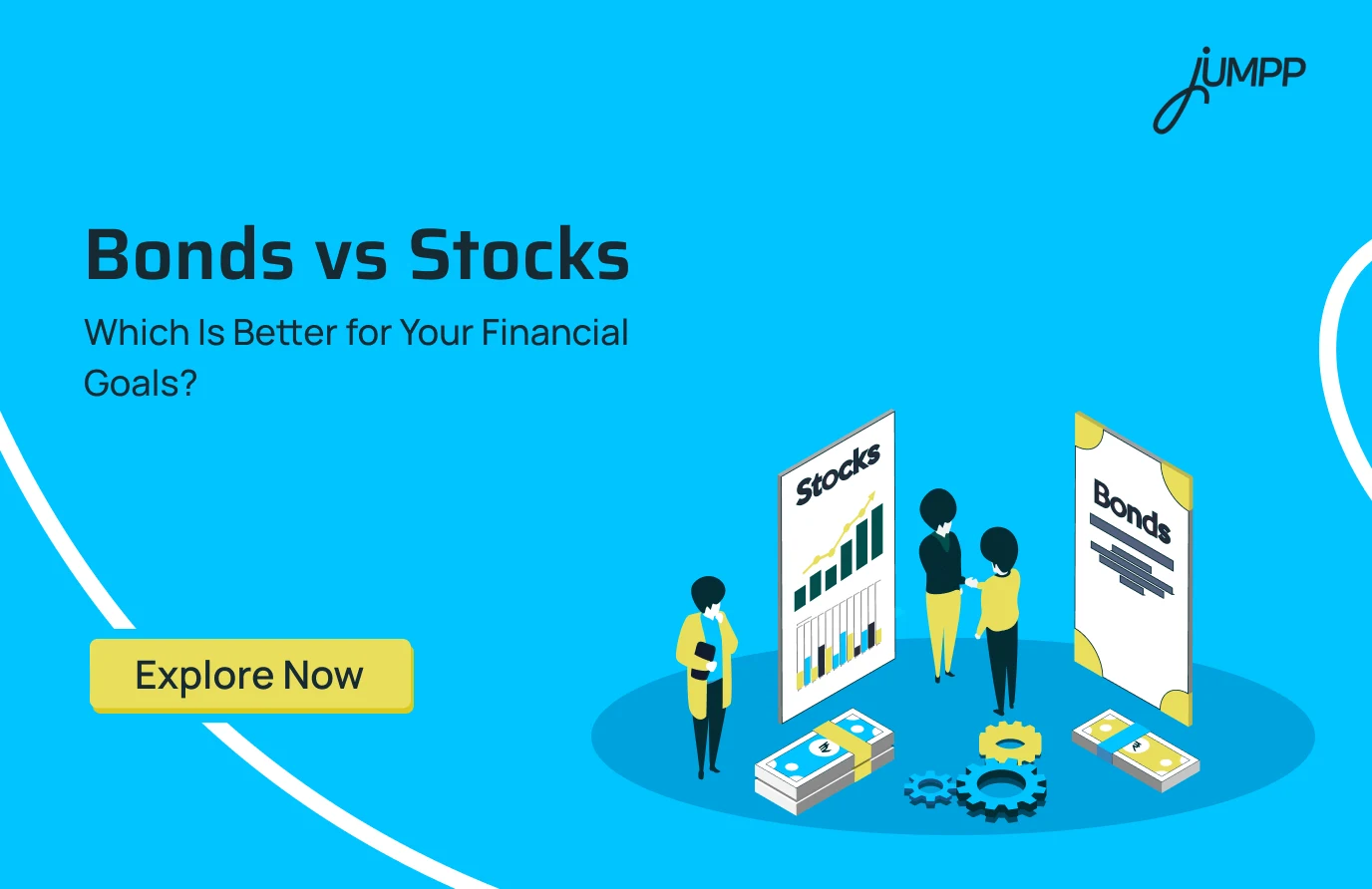
Stocks can grow your money faster, while bonds are often chosen for more stability. But that does not automatically make one better than the other. The real difference between stocks and bonds lies in how they work, what returns they offer and the risks you take.
Here’s a simple bonds vs stocks comparison to help you understand the trade-offs.
What Are Stocks?
Stocks represent ownership in a company.
When you buy a stock, you become a shareholder and may benefit if the company grows or pays dividends. The value of stocks can rise or fall based on company performance, market conditions and investor demand.
Characteristics of Stocks
Stocks have a few key characteristics that make them different from other investments:
- Ownership: Buying equity shares gives you part-ownership in a company.
- Market-linked value: Stock prices can rise or fall based on company performance, market conditions and investor demand.
- Potential returns: Investors may earn through price appreciation and dividends, if declared by the company.
- Voting rights: Equity shareholders generally get voting rights on certain company matters.
- No fixed returns: Returns from stocks are not predetermined and can vary over time.
- Tradability: Listed shares can be bought and sold on recognised stock exchanges.
Stocks may provide returns through dividends as well as price appreciation. Learn what a proposed dividend means, how it works and what investors should know before relying on dividend income.
Types of Stocks in India
Stocks can be classified in different ways. Two common classifications are based on the type of share and the size of the company.
1. Equity Shares
Equity shares represent ownership in a company. Equity shareholders generally have voting rights and may receive dividends if the company declares them.
2. Preference Shares
Preference shareholders generally get priority over equity shareholders for dividend payments and repayment of capital. Their exact rights depend on the terms of the shares issued.
Based on Market Capitalisation
- Large-cap stocks: Companies ranked 1st to 100th by full market capitalisation.
- Mid-cap stocks: Companies ranked 101st to 250th.
- Small-cap stocks: Companies ranked 251st onwards.
These categories help investors understand the relative size of listed companies, but they do not by themselves indicate whether a stock is safe or suitable for a particular investor.
Want to understand how investors assess trading activity? Learn more about volume in stock market, why it matters and how trading volume can help you analyse stocks.
What Are Bonds?
Bonds are debt instruments through which you lend money to a government, company or other issuer for a specified period. In return, the issuer generally pays interest and repays the principal at maturity.
Unlike stocks, bonds do not give you ownership in the issuing entity.
Characteristics of Bonds
- Debt investment: Buying a bond means lending money to the issuer rather than becoming an owner.
- Fixed maturity: Most bonds have a defined maturity date when the principal is due for repayment.
- Interest income: Many bonds pay interest, known as the coupon, at specified intervals.
- Market value can change: Bond prices may rise or fall before maturity depending on interest rates, credit quality and market conditions.
- Credit risk: There is a risk that the issuer may delay or fail to make interest or principal payments.
- Interest-rate risk: Bond prices generally move inversely to market interest rates.
- Tradability: Some bonds can be bought and sold in the secondary market before maturity.
- No ownership rights: Bondholders are creditors and generally do not receive voting rights in the issuing company.
Types of Bonds in India
Bonds can be classified based on who issues them, how they pay interest and their features.
1. Government Bonds
These are issued by the Central or State Governments to raise funds. Government securities issued by the Central Government are commonly known as G-Secs.
2. Corporate Bonds
Companies issue corporate bonds to borrow money from investors. Their interest rates and risks depend largely on the issuer’s creditworthiness and the terms of the bond.
3. Municipal Bonds
Municipal bodies may issue bonds to raise funds for infrastructure and other public projects.
4. Fixed-Rate Bonds
These bonds pay interest at a fixed coupon rate during the specified period.
5. Floating-Rate Bonds
The interest rate on these bonds changes periodically based on a specified benchmark or reset mechanism.
6. Zero-Coupon Bonds
Zero-coupon bonds do not make regular interest payments. They are generally issued at a discount and redeemed at their specified value on maturity.
7. Convertible Bonds
These bonds provide an option to convert the bond into shares of the issuing company according to specified terms.
8. Callable and Puttable Bonds
Callable bonds allow the issuer to redeem the bond before its scheduled maturity under specified conditions. Puttable bonds allow investors to seek early redemption according to the bond’s terms.
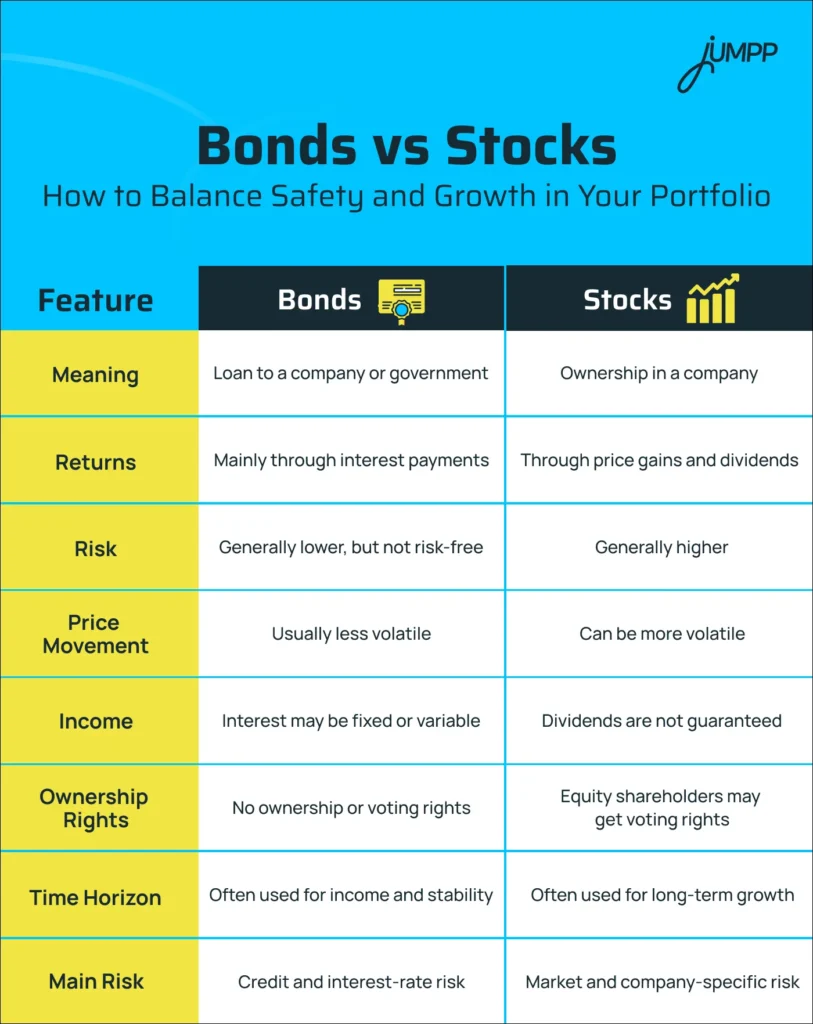
Bonds vs Stocks: How to Balance Safety and Growth in Your Portfolio
Stocks can offer higher growth potential but usually come with greater price volatility, while bonds generally provide more predictable income with relatively lower risk.
Here is the difference between bonds and stocks –
Advantages and Disadvantages of Stocks and Bonds
Stocks and bonds come with different benefits and risks.
Here is a brief look at the advantages and disadvantages of stocks and bonds.
| Investment | Advantages | Disadvantages |
| Stocks | Potential for capital growth; may provide dividend income; listed shares are generally easy to buy and sell | Prices can be volatile; returns are not fixed; company and market performance can lead to losses |
| Bonds | Can provide regular interest income; generally less volatile than stocks; principal is usually repaid at maturity subject to issuer terms | Returns may be lower than equities; exposed to credit and interest-rate risk; some bonds may have limited liquidity |
Are Bonds Riskier Than Stocks?
Generally, bonds are considered less volatile than stocks, but they are not risk-free.
Bond investors can still face credit risk, interest-rate risk and inflation risk, while stock prices can fluctuate more sharply with market and company performance.
Are Stocks Better Than Bonds?
Neither is automatically better. Stocks and bonds serve different purposes, with stocks generally offering higher growth potential and higher volatility, while bonds are typically used for relatively more predictable income and lower volatility.
The right choice depends on factors such as investment objective, time horizon and risk tolerance.
How to Invest in Stocks and Bonds in India
The first and foremost step to invest in stocks and bonds is to open a Demat account!
You can follow the steps below to begin-
- Open a Demat and trading account to hold and trade your stocks and bonds online.
- Learn the basics of how the stock market and bond market work before investing any amount.
- Decide whether you want to invest directly in individual stocks and bonds or through mutual funds and ETFs.
- Start with a small amount.
- You must diversify by mixing stocks for potential growth and bonds for stability to manage overall risk.
- It is important to keep a long-term perspective and avoid making impulsive decisions.
- Review your investments regularly to check if they are aligned with your financial goals
- Rebalance your portfolio when needed to maintain your desired stock-to-bond ratio.

Conclusion
Choosing between stocks and bonds is not about finding a single winner. The more useful approach is to understand what role each can play and evaluate them against your own financial priorities.
Before investing, consider the product features, costs, liquidity, taxation and risks involved rather than relying only on expected returns.
Manage More of Your Money with jUMPP
Beyond everyday payments, jUMPP brings multiple financial tools together in one app. Track expenses, invest in mutual funds and digital gold, manage bills, and explore other money-management features from one place.
Bonds vs Stocks- FAQs
Neither is always better. Bonds generally offer more predictable income and lower volatility, while stocks offer ownership and higher growth potential with greater market risk.
There is no single type of bond that is best for everyone. Government bonds, corporate bonds and other bond categories differ in credit risk, maturity, liquidity and returns.
Suppose you buy a bond with a face value of ₹20,000 and a 6% annual coupon. You may receive ₹1,200 in annual interest, subject to the bond terms, and the principal is repaid at maturity.
It depends on factors such as risk tolerance, investment horizon and financial objective. Shares generally have higher growth potential and volatility, while bonds are usually more focused on income and relative stability.
Investments generally considered relatively low-risk in India include government securities, bank fixed deposits and government-backed small savings schemes. However, each carries different liquidity, interest-rate and other risks.
Not all bonds are tax-free. Interest from most bonds is taxable, while certain specifically notified tax-free bonds may provide tax-exempt interest subject to applicable tax rules.
Stocks and bonds differ in risk, return potential, income structure and investment horizon, so the comparison depends on the investor’s objective and circumstances.
Bond returns may come from coupon or interest payments and, in some cases, changes in the bond’s market price. Actual returns depend on the bond type, interest rate, purchase price, maturity and issuer.
Stock returns can come from an increase in the share price and dividends, if declared. Returns are market-linked and are not fixed or guaranteed.
In an equity vs bonds comparison, equity represents ownership in a company, while bonds represent money lent to an issuer. Equity generally carries greater price volatility, whereas bonds have risks such as credit and interest-rate risk.
The bond market deals mainly in debt securities, while the stock market deals in shares representing company ownership.