Difference Between a Bank and an NBFC – Features, Risks, and Benefits
Today, many Indians use UPI daily, keep savings in banks, take EMIs through NBFCs, and still do not fully understand how differently these institutions work. Someone may trust a bank for salary and savings, but choose an NBFC for a quick bike loan or instant EMI because the process feels easier. But what is the difference between a bank and an NBFC?
Let’s see!
What is a Bank?
A bank is a financial institution licensed by the Reserve Bank of India (RBI) that accepts deposits, provides loans, and offers banking services like savings accounts, UPI, cheque books, ATMs, and online transfers. Banks are a core part of India’s payment and financial system.
Check out the top 10 private banks in India!
What is NBFC in Banking?
NBFC full form is Non-Banking Financial Company.
An NBFC is a financial company that offers loans, EMI financing, asset financing, and investment-related services, but it does not operate as a full-fledged bank. NBFCs cannot provide regular savings/current accounts like banks.
Can NBFCs Give Loans?
Yes, NBFCs can legally give loans in India. In fact, lending is one of the main services offered by NBFCs, including personal loans, gold loans, vehicle loans, business loans, and EMI financing.
Looking for a quick personal loan with a simple digital process? Explore loans on the personal loan app, jUMPP Finance, for faster approvals, flexible options, and smart money management features.
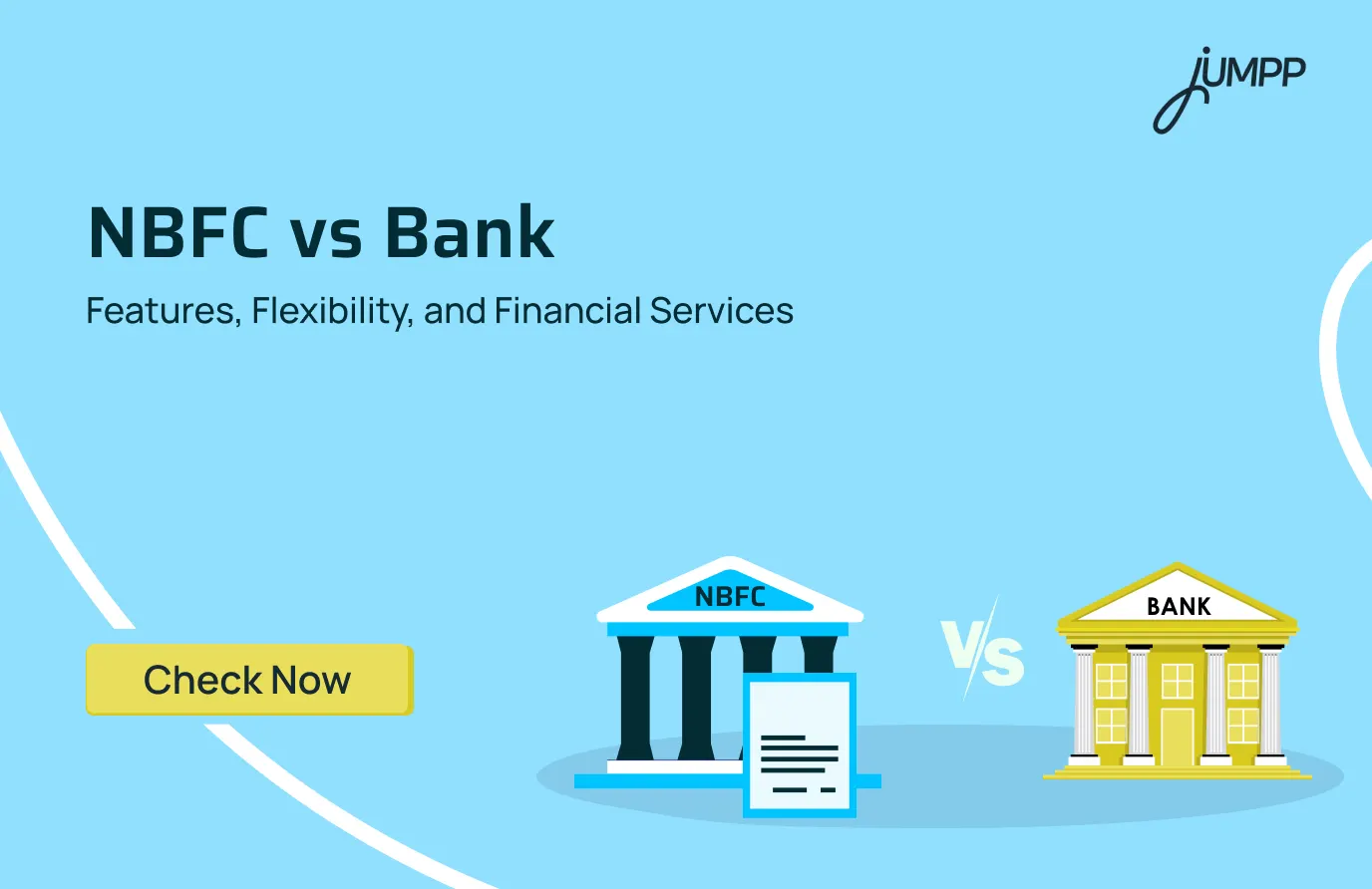
What is the Difference Between a Bank and an NBFC?
A bank is a licensed financial institution that can accept deposits, offer savings/current accounts, issue cheque books, and participate in the payment system. An NBFC (Non-Banking Financial Company) also provides loans and financial services, but it does not have a full banking licence like a bank.
Here is the simple difference between an NBFC and a bank –
| Basis | Bank | NBFC |
| Can accept savings/current deposits | Yes | No demand deposits |
| Cheque book facility | Yes | No |
| Part of the payment system | Yes | No |
| Regulation | RBI under the Banking Regulation Act | RBI under the RBI Act |
| Loan approval speed | Usually slower due to stricter checks | Often faster and more flexible |
| Interest rates on loans | Generally lower | Can be higher |
| Credit accessibility | Strict eligibility | Easier for low or limited-credit profiles |
| Deposit insurance | Protected by DICGC insurance | Usually not available |
For example, when someone opens a salary account, uses UPI, withdraws cash from an ATM, or writes cheques, they need a bank. But when someone wants a quick personal loan, bike loan, gold loan, or EMI financing with flexible approval, many people choose NBFCs because the process is often faster.
Know how to write a cancelled cheque!

What are the Advantages of banks?
Banks are usually considered better for savings, financial security, and complete banking services. They are ideal for people looking for long-term financial stability and lower-risk banking options.
- Savings accounts, fixed deposits, cheque books, and UPI services are available.
- Deposits are protected under DICGC insurance.
- Interest rates on loans are usually lower.
- Better suited for salary accounts and long-term financial planning.
- Strong RBI regulations provide higher financial stability.
- Easy access to ATMs, net banking, and payment systems.
- Suitable for customers with strong credit scores and stable income.
- Wide range of services including insurance, investments, and forex.
Want to manage your money better? Understanding your savings account balance helps you track expenses, maintain minimum balance requirements, and improve financial planning.
What are the Advantages of NBFCs Over Banks
NBFCs are often preferred for faster loans, flexible approvals, and easier access to credit. They play a major role in serving borrowers who may not easily qualify for traditional bank loans.
- Faster loan approval and quicker disbursal process.
- Simpler paperwork and documentation requirements.
- Flexible eligibility criteria for self-employed and first-time borrowers.
- Easier access for people with low or limited credit history.
- Strong focus on instant EMIs and digital lending.
- Better reach in rural and semi-urban areas.
- Useful for gold loans, vehicle loans, and consumer durable financing.
- Customised repayment options based on borrower needs.
- Many app-based personal loan platforms operate through NBFC models.
Why NBFCs Exist Even When We Already Have Banks
NBFCs exist because traditional banks cannot always provide fast, flexible, or accessible credit to every borrower. They help bridge financial gaps by serving customers and sectors that often struggle with conventional banking systems.
- Banks usually follow stricter lending rules, while NBFCs help serve borrowers needing faster or more flexible financing.
- Many rural and semi-urban areas depend heavily on NBFC-led financing networks.
- Small businesses and MSMEs often use NBFCs for working capital and business expansion.
- NBFCs support sectors like vehicle financing, microfinance, consumer durable loans, and affordable credit.
- India’s growing digital lending ecosystem relies heavily on NBFC infrastructure and partnerships.
- They improve financial inclusion by bringing credit access to underserved populations.
- NBFCs help increase overall liquidity and consumer spending in the economy.
- Banks and NBFCs together create a broader and more accessible financial ecosystem in India.
Bank vs NBFC: Which Is Better for Your Loans, Savings, and EMIs?
Banks are usually better for savings, lower-interest loans, and long-term financial security, while NBFCs are often better for faster approvals, flexible eligibility, and quick EMI financing.
The right choice depends on your financial needs, urgency, and credit profile.
| Financial Need | Bank | NBFC |
| Best Choice for Savings | Better for salary accounts, savings accounts, fixed deposits, and daily banking | Not commonly used for savings purposes |
| Best Choice for Personal Loans | Suitable for people with strong credit scores and stable income | Better for faster approvals and flexible eligibility |
| Best Choice for EMIs | Limited instant EMI options in many cases | Commonly used for mobile, electronics, bike, and appliance EMIs |
| Best for First-Time Borrowers | Approval may be difficult without a credit history | Easier access for new borrowers |
| Best for Self-Employed Individuals | Income proof requirements can be stricter | Flexible for freelancers, shop owners, and small business owners |
| Best for Rural and Small Businesses | Limited flexibility in some cases | Strong reach in rural financing and MSME lending |
| Security and Stability | Stronger deposit safety and banking protection | Mainly focused on lending and financing services |
| Best for Long-Term Financial Planning | Better for long-term banking relationships and financial products | Better for short-term borrowing convenience |
| Customer Flexibility | Fixed banking procedures and policies | More customised lending options |
Disclaimer– The rankings and figures in this article have been compiled from multiple verified reports, credible news sources, and public financial data available as of 2026.
All values are approximate and may vary with newer updates, revisions, or changes in official records.
Bank vs NBFC – FAQs
The main difference is that banks can accept savings/current deposits and offer full banking services, while NBFCs mainly provide loans and financing services. For example, State Bank of India is a bank, while Bajaj Finance is an NBFC focused on loans and EMIs.
Banks are usually better for savings, lower-interest loans, and long-term financial security. NBFCs are often better for faster loan approvals, flexible eligibility, and quick digital financing.
No, an NBFC is not a bank. An NBFC provides loans and financial services but cannot offer regular savings or current accounts like banks.
HDFC Bank is a bank. However, HDFC Ltd. originally operated as a housing finance company before merging with HDFC Bank.
The main types of financial institutions are commercial banks, NBFCs, cooperative banks, insurance companies, mutual fund companies, investment banks, and pension funds. These institutions help people save, invest, borrow, and manage money.
RBI divides NBFCs into four layers: Base Layer, Middle Layer, Upper Layer, and Top Layer. This system helps regulate NBFCs according to their size and financial risk.