Metropolitan Cities in India 2026: Top Metro Cities by Population, Economy, and Importance
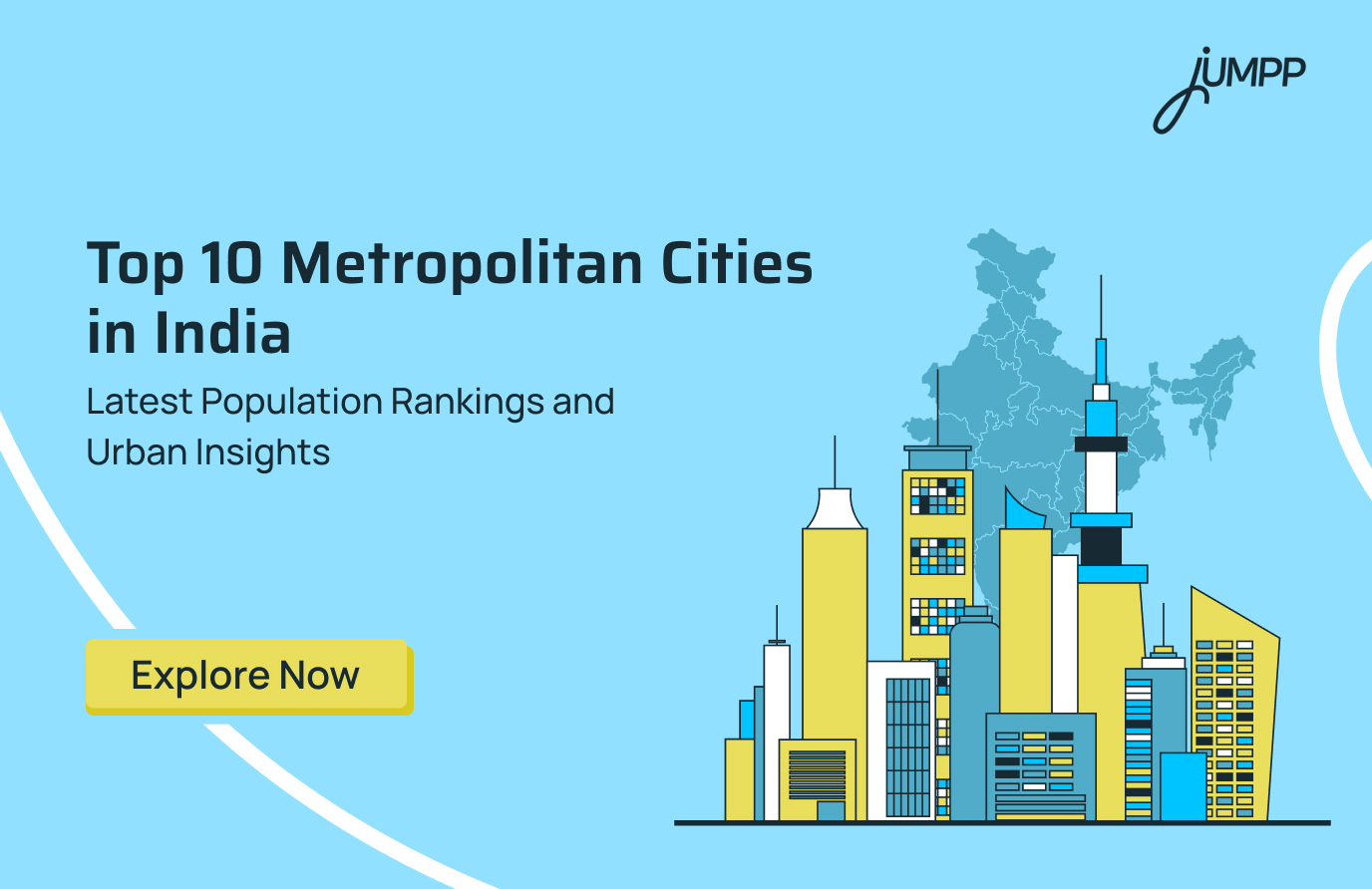
Every conversation about jobs, housing, traffic, or the cost of living in India eventually leads back to its metropolitan cities. These urban centres attract millions each year with the promise of better employment, education, and access to services. But how do these cities qualify as metropolitan cities, and which are the top 10 metropolitan cities in India?
Let us explore.
Metropolitan Cities in India (2026)
Metropolitan cities are urban regions with very large populations and strong economic importance. Under the 74th Constitutional Amendment of India, a metropolitan area is defined as an urban region with a population of more than one million.
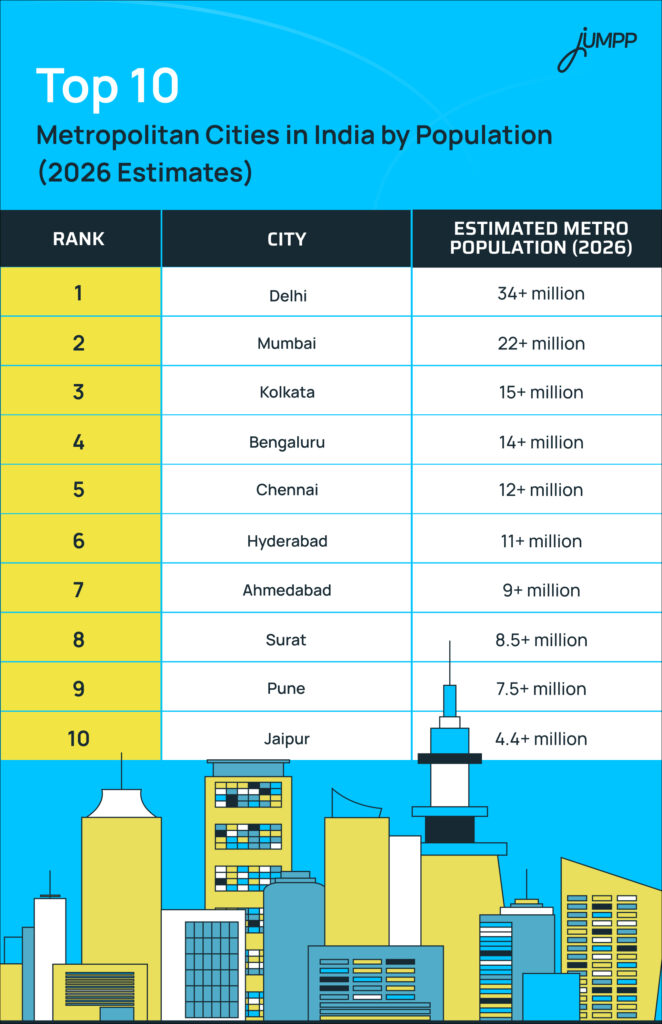
By 2026 population estimates, these ten cities stand out as India’s largest metropolitan centres. They are not only population-heavy but also act as economic, administrative, cultural, and employment hubs for the country.
Source: https://worldpopulationreview.com/
City-wise Overview of Metropolitan Cities in India
The following section explains the top 10 metropolitan cities in India based on population and urban importance. These metro cities in India form the core of the country’s economic, administrative, and cultural framework. If someone asks to name the metropolitan cities of India, this metro city list in India represents the most prominent ones as of 2026.
1. Delhi’s Population
Estimated metro population (2026): 34+ million
Delhi is the largest among the metropolitan cities in India. Its metropolitan region spreads across the National Capital Region, including Gurugram, Noida, Ghaziabad, and Faridabad. As the political capital, it houses Parliament, the Supreme Court, and key government offices. Delhi reflects the scale and complexity seen in major metro cities in India, combining historical heritage with modern infrastructure.
2. Mumbai’s Population
Estimated metro population (2026): 22+ million
Mumbai is one of the most important metropolitan cities in India and is widely recognised as the financial and commercial capital of the country. It is home to major banks, stock exchanges, corporate headquarters, and the Hindi film industry. Despite space limitations, Mumbai continues to attract migrants, highlighting why it consistently ranks among the top metro cities in India.
Many of India’s biggest sports icons live and work in these major metro cities. Explore the complete list of the top 10 richest cricketers in India and see how India’s urban hubs contribute to sporting success and wealth creation.
3. Kolkata’s Population
Estimated metro population (2026): 15+ million
Kolkata is a historically significant metropolitan city in India, known for its cultural, literary, and political influence. Its metropolitan region supports trade, education, port activities, and traditional industries. Among the metropolitan cities in India, Kolkata remains a key economic centre in the eastern region.
4. Bengaluru’s Population
Estimated metro population (2026): 14+ million
Bengaluru stands out in the metro city list in India as the country’s leading technology and innovation hub. Often referred to as the Silicon Valley of India, it attracts professionals from across India and abroad. The city plays a central role in software exports, startups, and research-driven industries, making it one of the fastest-growing metropolitan cities in India.
5. Chennai’s Population
Estimated metro population (2026): 12+ million
Chennai is a major industrial metropolitan city in India with strengths in automobile manufacturing, electronics, ports, and exports. It is also widely known for medical tourism. The city’s infrastructure and industry presence firmly place it among the top 10 metropolitan cities in India.
6. Hyderabad’s Population
Estimated metro population (2026): 11+ million
Hyderabad has grown rapidly and is now a major centre for information technology, pharmaceuticals, and biotechnology. It balances historic landmarks with modern business districts. Among the metro cities in India, Hyderabad has emerged as a strong contributor to employment and urban expansion.
7. Ahmedabad’s Population
Estimated metro population (2026): 9+ million
Ahmedabad is the largest city in Gujarat and an important metropolitan city in India. It plays a significant role in textiles, chemicals, pharmaceuticals, and manufacturing. The city’s UNESCO World Heritage City status also adds cultural value to the metro city list in India.
8. Surat’s Population
Estimated metro population (2026): 8.5+ million
Surat is one of the fastest-growing metropolitan cities in India. Known globally for diamond cutting and polishing and textile manufacturing, the city is also recognised for efficient urban planning and a business-friendly environment. Its growth highlights the changing profile of metro cities in India.
9. Pune’s Population
Estimated metro population (2026): 7.5+ million
Pune is a well-established metropolitan city in India with a strong presence in education and information technology. It attracts students and professionals due to its universities, IT parks, and relatively balanced urban lifestyle. Pune continues to strengthen its position in the metro city list in India.
10. Jaipur’s Population
Estimated metro population (2026): 4.4+ million
Jaipur, the capital of Rajasthan, is a growing metropolitan city in India driven by tourism, trade, and small industries. Known as the Pink City, Jaipur combines heritage architecture with expanding urban infrastructure, completing the list when people ask how many metropolitan cities in India dominate by population.
India’s metropolitan cities continue to shape how the country works, grows, and creates opportunity, acting as centres of population, employment, infrastructure, and economic decision-making.
Metro cities like Mumbai and Delhi are also home to India’s biggest entertainment stars. Read more about the richest singers in India and understand how urban ecosystems help shape successful creative careers.
Disclaimer– The rankings and figures in this article have been compiled from multiple verified reports, credible news sources, and public financial data available as of 2025.
All values are approximate and may vary with newer updates, revisions, or changes in official records.
Metropolitan Cities in India- FAQs
The top 10 metropolitan cities in India by population are Delhi, Mumbai, Kolkata, Bengaluru, Chennai, Hyderabad, Ahmedabad, Surat, Pune, and Jaipur. These cities are the country’s primary economic and administrative centres.
Delhi is the largest city in India by area, followed by Bengaluru, Hyderabad, Mumbai, Ahmedabad, Jaipur, Chennai, Pune, Surat, and Kolkata. Their size reflects extensive urban expansion and infrastructure growth.
India’s four traditional metropolitan cities are Delhi, Mumbai, Kolkata, and Chennai. These cities historically shaped India’s political, commercial, and cultural development.
Hyderabad is the fastest-growing city in India in 2025. Its growth is driven by technology investments, infrastructure development, and rising employment opportunities.
Hyderabad, Bengaluru, Pune, Ahmedabad, and Surat are among the fastest-growing Indian cities. Their expansion is supported by strong industrial, IT, and business ecosystems.
The top five megacities in India are Delhi, Mumbai, Kolkata, Bengaluru, and Chennai. Each city has a population exceeding ten million.
India officially has 9 major metropolitan cities that are widely recognised for their population size and economic importance, including Mumbai, Delhi, Kolkata, Chennai, Bengaluru, Hyderabad, Ahmedabad, Pune, and Surat.
Beyond these, India has over 40 million-plus cities, each with a population exceeding one million.