List of the Top 10 Richest Cities in India by GDP in 2026
Some cities earn more in a year than entire small countries, and ten of them alone generate nearly half of India’s urban wealth. From Mumbai’s trading floors to Bengaluru’s tech corridors, India’s economic story is really a story of its cities. Here’s the updated 2026 ranking of the richest cities in India by GDP, along with what drives each one’s economy.
Top 10 Richest Cities in India by GDP 2026
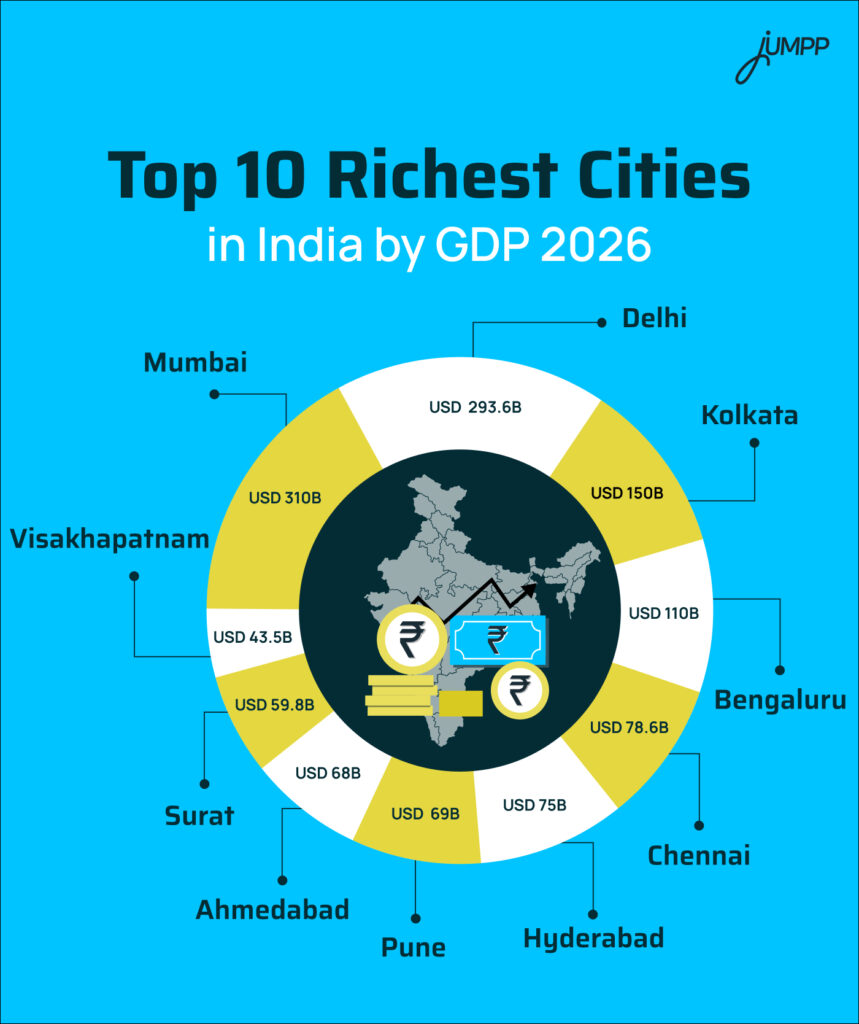
Top 10 Richest Cities in India by GDP 2026
| Rank | City | Estimated Population (2026) | GDP (USD Billion) | Per Capita Income (₹ Lakh per year) |
| 1 | Mumbai | 20,385,414 | 310.0 | 4.13 |
| 2 | Delhi | 30,446,254 | 293.6 | 4.61 |
| 3 | Kolkata | 22,646,412 | 150.0 | 1.54 |
| 4 | Bengaluru | 13,261,056 | 110.0 | 3.52 |
| 5 | Chennai | 11,192,733 | 78.6 | 3.15 |
| 6 | Hyderabad | 9,216,127 | 75.0 | 4.00 |
| 7 | Pune | 6,871,873 | 69.0 | 2.78 |
| 8 | Ahmedabad | 7,667,167 | 68.0 | 3.89 |
| 9 | Surat | 6,970,910 | 59.8 | 3.89 |
| 10 | Visakhapatnam | 2,601,00 | 43.5 | 4.83 |
Source: Data from Facttodata and statistics times as of July 1, 2026.

Top 10 Richest Cities in India by GDP in 2026: The Real Urban Powerhouses
Every metropolis on this list has its own rhythm, shaped by its people, industries, and history.
Let us now look at what makes each of these Indian cities by GDP stand out and understand why Mumbai continues to hold the title of the richest city in India.
1. Mumbai
Mumbai’s story begins on a cluster of seven islands inhabited by the Koli and Aagri communities since ancient times. One key moment came when the Portuguese ceded the islands, and they were eventually leased by the British East India Company, which transformed them into a major port and commercial centre in the 17th–18th centuries.
- GDP: USD 310+ Billion (~6% of India’s total GDP)
- Major Industries: Banking, Stock Market, Entertainment, Shipping, Real Estate
- Home to: Bombay Stock Exchange (BSE), National Stock Exchange (NSE), RBI headquarters, and Bollywood
- Origins: Grew from seven islands into a major port under British rule (17th–18th century)
Quick facts:
- Home to 28,000+ millionaires and 50+ billionaires, the highest in India
- Dharavi’s informal economy (leather, textiles, recycling) generates over $1 billion a year
Famous places: Gateway of India, Marine Drive, Chhatrapati Shivaji Terminus, Elephanta Caves, and Bandra–Worli Sea Link
2. Delhi
Delhi is one of the oldest continuously inhabited cities in the world. Legend links it to the 1st century BCE king Dhilu. In around 1052 CE, the Tomar king Anangpal Tomar II is credited with founding the earlier fortification Lal Kot in the region. Over the centuries, Delhi has served as the seat of the Delhi Sultanate, the Mughal Empire, the British Raj, and is now the capital of independent India.
- Famous places: Red Fort, Qutub Minar, Humayun’s Tomb, India Gate, and Lotus Temple
- GDP: USD 293.6 Billion (~4.94% of India’s GDP)
- Major Industries: Government & Administration, IT, Telecommunications, Banking, Real Estate, and Tourism
- Home to: Parliament of India, central ministries, foreign embassies, major corporate HQs
- Origins: One of the world’s oldest continuously inhabited cities; capital under multiple empires
- Quick fact: Highest per capita income among India’s largest cities (₹4.61 lakh/year), ahead of even Mumbai
- Famous places: Red Fort, Qutub Minar, Humayun’s Tomb, India Gate, and Lotus Temple
3. Kolkata
The modern city of Kolkata emerged from the villages of Sutanuti, Kalikata, and Gobindapur on the Hooghly River. In 1690, the British East India Company established a trading post there, which later became the capital of British India until 1911.
- GDP: USD 150 Billion
- Major Industries: Banking, Steel, Manufacturing, Port & Logistics Trade
- Home to: Kolkata Port (India’s oldest operating port), major jute and engineering industries
- Origins: British trading post from 1690; capital of British India until 1911
- Quick fact: Was the economic capital of British Asia for over 150 years before Delhi took over politically
- Famous places: Victoria Memorial, Howrah Bridge, Kalighat Temple, and Sundarbans
Explore the Top 10 richest states in India!
4. Bengaluru
Bengaluru (formerly Bangalore) was formally founded in 1537 CE by the chieftain Kempe Gowda I under the Vijayanagara Empire.
- GDP: USD 110 Billion (~1.87% of India’s GDP)
- Major Industries: Information Technology, Startups, Biotechnology, Aerospace
- Home to: India offices of Google, Amazon, Microsoft, Meta; ISRO headquarters
- Origins: Founded in 1537 by chieftain Kempe Gowda I
- Quick fact: Produces more software exports than the rest of South India combined
- Famous places: Bangalore Palace, Lalbagh Botanical Garden, Cubbon Park, and Vidhana Soudha
5. Chennai
The city now known as Chennai began as the fishing village of Madraspatnam on the Coromandel coast. In 1639, the English East India Company acquired a strip of land and built Fort St George, which became the nucleus of the modern city.
- GDP: USD 78.6 Billion
- Major Industries: Automobile Manufacturing, IT & Software Services, Heavy Engineering
- Home to: Major plants of Ford, Hyundai, and Royal Enfield
- Origins: Grew from the fishing village of Madraspatnam after Fort St George was built in 1639
- Quick fact: Nicknamed “Detroit of India”, it produces nearly 40% of India’s automobile exports
- Famous places: Marina Beach, Fort St George, Kapaleeshwarar Temple, San Thome Basilica
6. Hyderabad
In 1591 CE, Sultan Muhammad Quli Qutb Shah of the Qutb Shahi dynasty founded Hyderabad on the south bank of the Musi River.
- GDP: USD 75 Billion
- Major Industries: IT (“Cyberabad”), Pharmaceuticals & Biotech, Vaccine Manufacturing
- Home to: HITEC City (Google, Microsoft, Amazon, Apple), Genome Valley (Dr. Reddy’s, Bharat Biotech, Aurobindo Pharma)
- Origins: Founded in 1591 by Sultan Muhammad Quli Qutb Shah
- Quick fact: Produces ~35% of India’s bulk drugs and close to a third of the world’s vaccine doses; the “Vaccine Capital of the World”
- Famous places: Charminar, Golconda Fort, Hussain Sagar Lake, Salar Jung Museum
7. Pune
Pune’s origins go back to early medieval times (the 9th century mentions ‘Punnaka’), but it rose to prominence in the 17th–18th centuries as the seat of the Maratha Peshwas.
- GDP: USD 69 Billion
- Major Industries: Automobile Manufacturing, IT, Higher Education
- Home to: Tata Motors and Bajaj Auto plants, 100+ colleges and universities
- Origins: Rose to prominence as the seat of the Maratha Peshwas (17th–18th century)
- Quick fact: Nicknamed “Oxford of the East”, it trains more engineers yearly than most Indian states
- Famous places: Shaniwar Wada, Aga Khan Palace, Sinhagad Fort (nearby), Pataleshwar Cave Temple
8. Ahmedabad
Ahmedabad was founded on 26 February 1411 CE by Sultan Ahmad Shah I of the Gujarat Sultanate, on the banks of the Sabarmati River. The walled city remains a remarkable heritage site.
- GDP: USD 68 Billion
- Major Industries: Textiles (denim & synthetic fibre), Chemicals, Pharmaceuticals, Engineering Goods
- Home to: Adani Group and Torrent Group HQs; GIFT City (India’s first International Financial Services Centre) nearby
- Origins: Founded in 1411 by Sultan Ahmad Shah I on the Sabarmati River
- Quick fact: Close proximity to Mundra and Kandla ports makes it one of India’s best-connected industrial cities
- Famous places: Sabarmati Ashram, the historic walled city (UNESCO World Heritage Site), Jama Masjid
9. Surat
Surat has a long history as a coastal trading port on the Arabian Sea, flourishing especially under the Mughals and later the British.
- GDP: USD 59.8 Billion
- Major Industries: Diamond Cutting & Polishing, Textiles
- Home to: Surat Diamond Bourse, the largest office building in the world by floor area, bigger than the Pentagon
- Origins: Historic Mughal-era coastal trading port
- Quick fact: Cuts and polishes roughly 9 of every 10 diamonds sold worldwide; the industry employs 800,000+ workers
- Famous places: Surat Castle, Dumas Beach, Sardar Patel Museum
10. Visakhapatnam
Visakhapatnam (also called Vizag) is an ancient settlement that grew around a natural harbour on India’s eastern coast. Historically part of various dynasties in Andhra Pradesh, it has transformed into a modern industrial and port city.
- GDP: USD 43.5 Billion
- Major Industries: Port & Shipping Trade, Steel, IT (emerging), Pharmaceuticals
- Home to: Visakhapatnam Port, Indian Navy’s Eastern Naval Command, Vizag Steel Plant
- Origins: Ancient harbour settlement on India’s eastern coast
- Quick fact: Highest per capita income on this list (₹4.83 lakh/year), despite having the smallest population
- Famous places: Borra Caves, Kailasagiri Hill Park, INS Kurusura Submarine Museum, Rishikonda Beach
Conclusion
These cities didn’t build their wealth by sitting on it; they built it by putting capital into motion, again and again. Your own money can follow the same principle. Whether you are just starting out or looking to grow what you already have, choosing the best app for investment can make it easier to turn everyday savings into long-term wealth, no matter which of these cities you call home.
Disclaimer- The rankings and figures in this article have been compiled from multiple verified reports, credible news sources, and public financial data available as of 2026. All values are approximate and may vary with newer updates, revisions, or changes in official records.
Top 10 Richest Cities in India- 2026 FAQs
The top 10 richest cities in India by GDP (2026) are Mumbai, Delhi, Kolkata, Bengaluru, Chennai, Hyderabad, Pune, Ahmedabad, Surat, and Visakhapatnam, with Mumbai leading at 310 billion USD.
The five richest states in India in 2026 are Maharashtra, Tamil Nadu, Karnataka, Gujarat, and Uttar Pradesh, with Maharashtra topping the list at ₹42.67 lakh crore.
The western and southern regions of India are the richest, led by Maharashtra, Gujarat, Karnataka, and Tamil Nadu, which together contribute a major share of the country’s GDP.
Pune is the 7th richest city in India, with a GDP of 69 billion USD, known for its automobile industries, education hubs, and growing technology sector.
Mumbai district in Maharashtra is the richest district in India, contributing the most to the state’s GSDP and serving as the nation’s economic and financial hub.