How Does the Power of Compounding Help Your Money Grow?
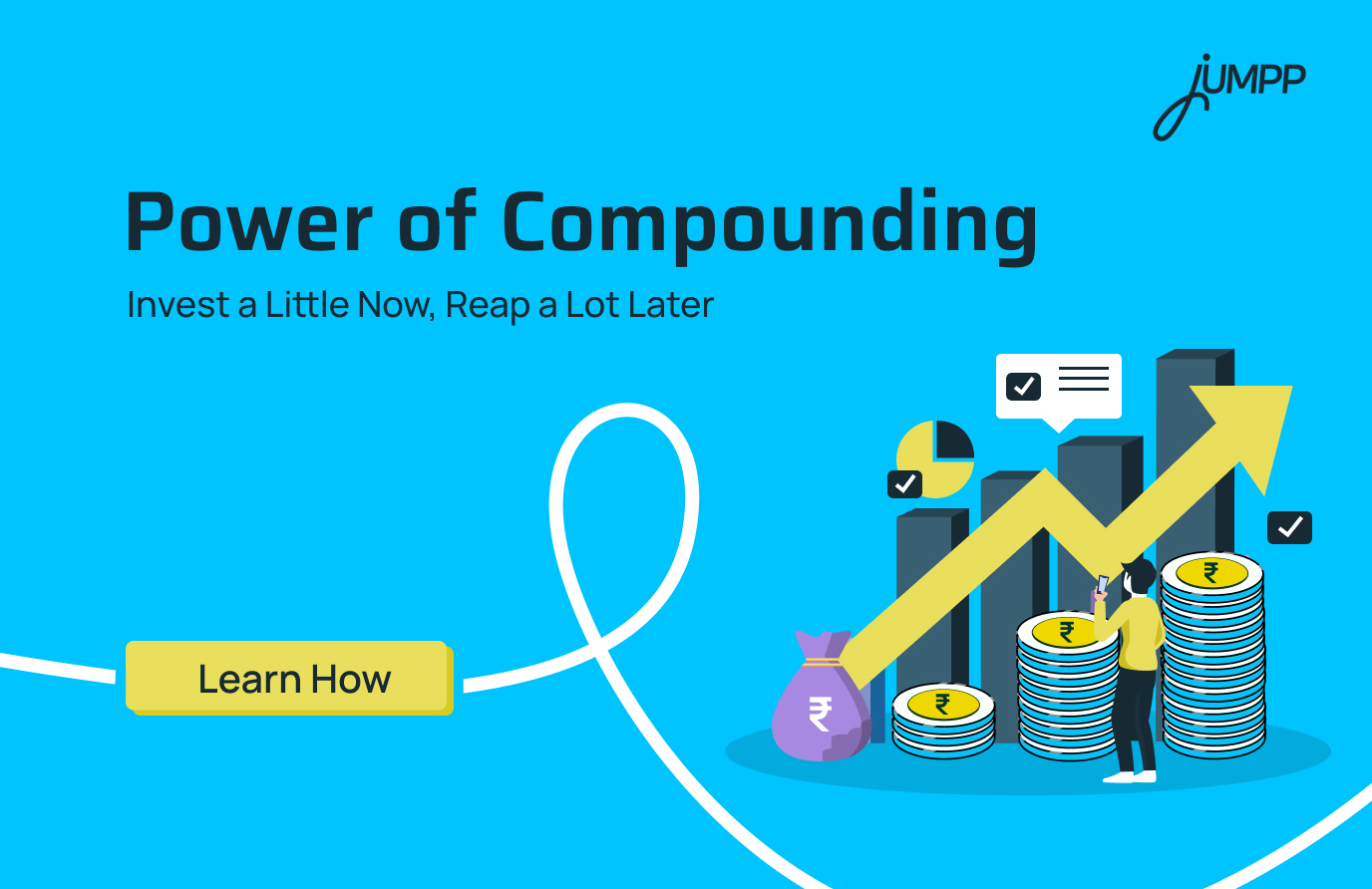
Most people still believe that saving money alone is enough to build long-term wealth and ensure their financial security. But here’s the truth. Your savings lose value every day due to inflation. The only way to truly grow your money is through the power of compounding, where your returns start earning their own returns.
Small steps today become giant leaps over time. It rewards patience, consistency, and the courage to begin.
Let’s learn about saving and the power of compounding!
What is Compounding?
It’s the process where your money grows by earning interest on both your initial investment and the interest it has already earned. This happens through compound interest, and it’s what makes long-term investing so powerful.
Power of Compounding Example
You invest ₹1,000 at 10%.
- Year 1: You earn ₹100 → total becomes ₹1,100.
- Year 2: Interest applies on ₹1,100 → you earn ₹110 → total ₹1,210.
- Year 3: Interest applies on ₹1,210 → you earn ₹121 → total ₹1,331.
Your money climbs faster each year because you’re earning interest on interest.
What are the key advantages of compounding?
These are the key advantages of compound interest:
- Money multiplies over time, letting small amounts grow big.
- Returns increase with time, giving your investment more momentum.
- Growth happens automatically, without extra effort from you.
- Savings feel more rewarding, motivating you to stay consistent.
What is the compound interest formula?
Compound interest is the interest you earn on your principal and on the interest that keeps building over time. This helps your investment grow faster with every compounding period.
Compound Interest Formula
Compound Interest = P × [(1 + i)ⁿ – 1]
Where:
- P = principal amount (your starting money)
- i = interest rate per period
- n = number of compounding periods
This formula helps you calculate how quickly your money can grow when compounding works in your favour.
What Are the Types of Compounding?
Interest can be added at different intervals, and each one affects how fast your money grows.
- Daily Compounding – Interest is compounded daily.
- Quarterly Compounding – Interest is added every three months.
- Half-Yearly Compounding – Interest is added twice a year.
- Annual Compounding – Interest is added once a year.
The more frequently interest is compounded, the higher your future value grows, a key part of saving and the power of compounding.
Key Factors That Make Compounding Powerful
- Time – The earlier you start, the bigger your returns.
- Reinvestment – Keep your money invested instead of withdrawing it.
- Higher Returns – A higher interest rate grows your money even faster.
Investment Strategies Using Compounding
If you are wondering how to start compounding, these simple strategies help your money pick up steady momentum:
1. Start Early: The earlier you invest, the more your returns multiply. Starting at 25 instead of 35 can create crore-level differences over long-term compounding.
Here’s how to define your short-term and long-term financial goals.
2. Be Consistent: Invest regularly to keep your growth on track. With SIP compounding, even ₹2,000 a month at 12% can grow to nearly ₹50 lakhs in 30 years.
3. Reinvest Your Returns: Let your gains stay invested so compounding accelerates. Reinvesting ₹1 lakh at 7% for 20 years grows to ₹3.87 lakhs, much higher than taking the interest out yearly.
4. Choose the Right Investment Options: Some options offer stronger compounding benefits: Mutual Funds (SIP) for long-term growth, PPF for safe compounding, Stocks for high potential, and FDs with compounding for stable returns.
Note: These examples are for illustration only. Actual returns may vary based on market conditions. Always research or consult a financial expert before investing.
Compounding Investment
A compounding investment is one in which your returns are added back to your principal, helping your money grow faster through long-term compounding.
When you invest in assets like mutual funds, SIPs, or PPFs, your profits, dividends, or interest are reinvested automatically. Over time, you earn returns not just on your starting amount but also on everything your investment has already earned.
How Does Compounding Work in Mutual Funds?
When you invest in mutual funds, compounding plays a key role.
Mutual funds generally offer higher returns than traditional savings accounts, and when those returns are reinvested, this begins the power of compounding.
Let’s say you invest ₹50,000 in a mutual fund earning 12% annually. Here’s how your amount grows:
| Year | Amount at Year-End |
| Year 1 | ₹56,000 |
| Year 2 | ₹62,720 |
| Year 3 | ₹70,246 |
Your returns grow each year because you earn interest on the previous year’s gains.
Best Investments for Compounding Growth
If you want a strong compounding investment, these options help your money build momentum over time:
- SIP (Systematic Investment Plan): For regular investors, a SIP (Systematic Investment Plan) makes compounding even more accessible. With compounding in SIP, every monthly contribution grows along with the returns generated over time.
- Mutual Funds: Equity or hybrid funds reinvest gains, accelerating wealth creation.
- Stocks (Long-Term Holding): Growing companies reinvest profits, boosting your capital over the years.
- Public Provident Fund (PPF): Safe, tax-efficient, and designed for long-term compounding.
- Fixed Deposits (FDs): Compounded interest grows your savings at a predictable rate.
Saving and the Power of Compounding: It’s Not Just About Investing
The savings and power of compounding work together to create a strong financial foundation. When you deposit money in a high-interest savings account or fixed deposit (FD), the interest on your savings compounds over time, leading to larger payouts. While investments typically offer higher returns, using compounding with savings can still yield significant growth, especially if you are consistent with deposits.
If you save ₹10,000 in a fixed deposit at 6% annual interest, after one year, you will earn ₹600. The next year, your interest will be calculated at ₹10,600, and so on.
Simple Interest vs Compound Interest
| Basis | Simple Interest | Compound Interest |
| Meaning | Interest is calculated only on the original principal amount. | Interest is calculated on the principal and accumulated interest. |
| Growth | Grows steadily over time. | Grows faster due to the compounding effect. |
| Formula | SI = (P × R × T) / 100 | CI = P × [(1 + R/100)^T – 1] |
| Interest Earned On | Principal only. | Principal + Interest from previous periods. |
| Returns | Lower compared to compound interest over the long term. | Higher returns in the long run. |
| Used In | Short-term loans, car loans, and personal loans. | Long-term investments, savings accounts, FDs, and PPF. |
To make it easier, you can use online compound interest calculators. Just enter your investment amount, interest rate, and duration, and they will show you how much your money can grow.
Final Thoughts
The power of compounding can turn small, steady investments into long-term wealth, especially when you start early and stay consistent. Whether it’s SIPs, PPF, stocks, or FDs, investing regularly and reinvesting your returns can help you achieve your financial goals effortlessly.
Open a zero-balance savings account with jUMPP and take your first leap towards smarter money growth.
Power of Compounding: FAQs
Compounding means earning interest on your interest. It helps your money grow faster over time.
The 8-4-3 rule shows how an investment grows through compounding: 8 years of steady growth, followed by 4 years of doubling, and 3 years of exponential doubling. It shows how compounding accelerates returns over time.
The “Rule of 72” helps estimate how long it takes for an investment to double by dividing 72 by the annual interest rate. It offers a quick way to understand compound interest growth.
Money compounding means your money earns interest, and that interest earns even more interest, making your savings grow quickly.
You can get 10% interest by investing in high-yield savings accounts, stocks, or mutual funds that offer this return.
The fastest way to compound money is by investing in assets that have the potential to grow at higher rates over long periods, such as equity mutual funds or stocks, and allowing the returns to stay invested. The key is not speed, but consistency.