Hyperinflation: How It Starts, Why It Spreads, and How It Impacts an Economy
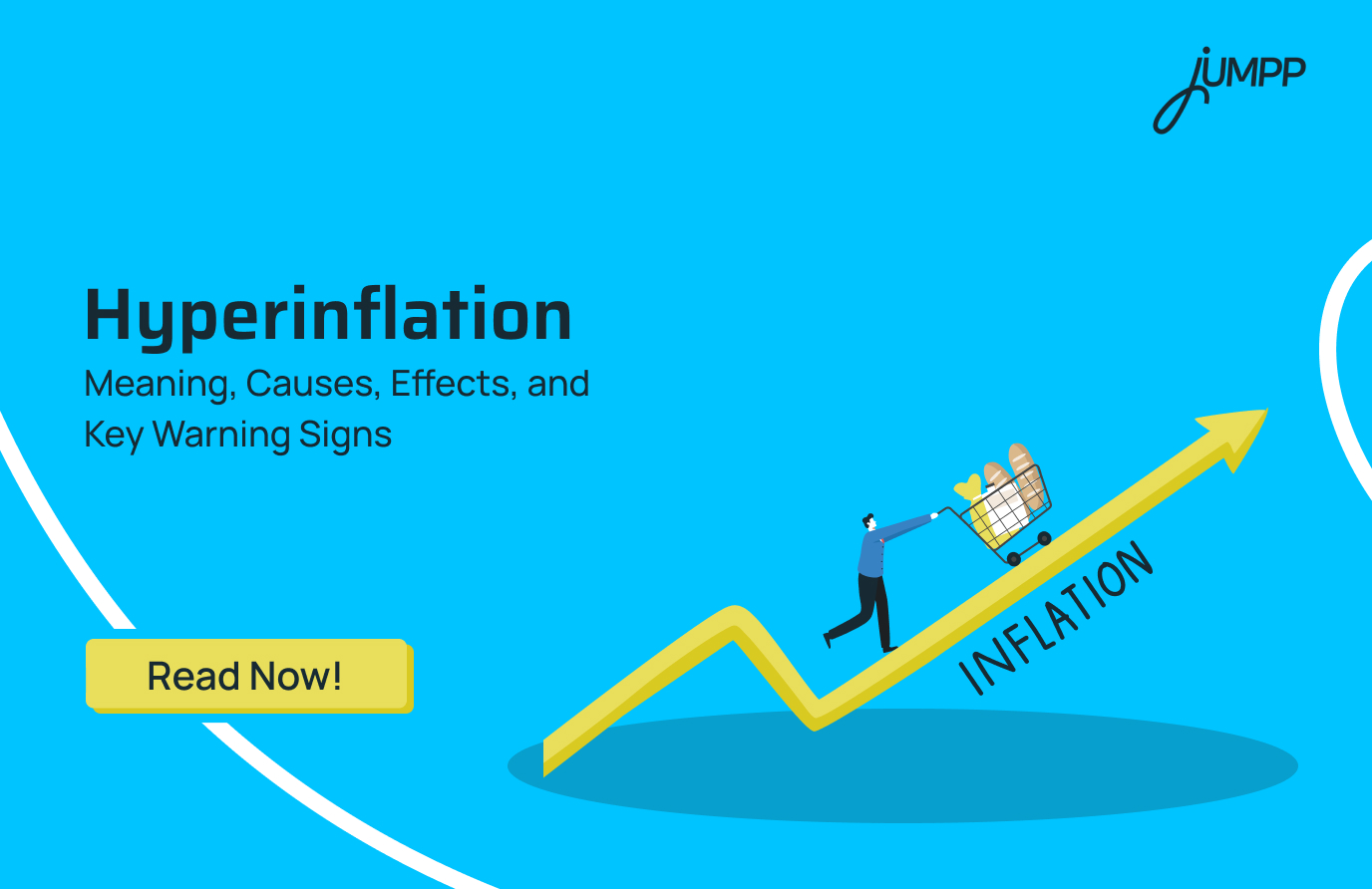
Throughout history, economies that experienced hyperinflation followed a similar pattern. There were instances of excessive money creation, weakening of the government institutions, and declining public confidence. Let us understand what hyperinflation really means and why it is such a serious economic concern.
Hyperinflation Meaning
Hyperinflation is an extreme economic phenomenon in which prices for goods and services rise uncontrollably. This can often exceed 50 percent per month. The situation causes the currency to lose value rapidly.
How Hyperinflation Starts?
Hyperinflation starts with a massive and rapid increase in the money supply.
- This is usually when a government prints excessive currency to fund large debts, finance wars, or manage prolonged economic crises.
- As confidence in money weakens, people rush to spend wages immediately, hoard essential goods, and abandon saving altogether.
- Demand rises while supply remains constrained. This creates a vicious cycle where more money chases fewer goods.
- Prices begin rising uncontrollably, as trust in the currency collapses and monetary stability evaporates.
Countries with Hyperinflation
Countries that have experienced hyperinflation, or inflation levels dangerously close to it, include Venezuela, Zimbabwe, Sudan, South Sudan, Argentina, Lebanon, Sierra Leone, and Iran.
In addition, countries such as Turkey, Ghana, and Haiti have faced persistently high inflation and severe currency stress. It is important to note that hyperinflation classifications vary by definition, data source, and time period, and economic conditions can change rapidly based on policy responses, political stability, and external shocks.
What are the Causes of Hyperinflation?
A hyperinflation crisis is almost always caused by a combination of two primary economic factors that create a self-reinforcing downward spiral.
1. Excessive money supply
The most common cause of hyperinflation is the unchecked expansion of the money supply without a corresponding increase in real economic output.
- Governments may begin printing money to fund excessive public spending or to service large national debts when tax revenues are insufficient. This artificial injection of money weakens currency value.
- Historical episodes, such as Germany in the 1920s and Hungary in the 1940s, show governments resorting to large-scale money printing to fund war expenses or post-war reparations, triggering runaway inflation.
- As more money enters circulation, each unit buys less. This forces authorities to print even more money to meet rising costs, further accelerating inflation.
2. Demand pull inflation
Hyperinflation is intensified when demand grows far faster than the economy’s ability to supply goods and services.
- When people expect prices to rise continuously, they spend money immediately on available goods. This rapid circulation of money increases demand sharply, pushing prices even higher.
- Wars, political instability, natural disasters, or production collapses reduce the availability of essential goods such as food and fuel. Severe shortages combined with rising demand result in explosive price increases.
Secondary contributing factors
- When citizens lose faith in economic governance, they may abandon the local currency entirely and shift towards foreign currencies, assets, or barter systems.
- International sanctions, declining export revenues, heavy foreign debt, or dependence on a single commodity can accelerate currency collapse and intensify inflationary pressures.
During periods of hyperinflation, countries heavily dependent on fuel and commodities face sharper currency shocks. Understanding what is black gold helps explain why oil prices, energy imports, and commodity reliance can accelerate inflation and economic instability.
What are the Signs of Hyperinflation?
Detecting the onset of hyperinflation requires close observation of both economic data and behavioural shifts. As of 2025, economists and international standards such as IAS 29 identify several early warning signals.
Persistently high inflation over time, where cumulative inflation over three years approaches or exceeds 100 percent.
Sharp monthly price increases, often exceeding 50 percent in a single month, which is the commonly accepted threshold for hyperinflation.
Rapid expansion of the money supply, as governments print large amounts of currency to fund deficits or repay debt when borrowing options disappear.
Severe currency depreciation, with the local currency losing value quickly against stable foreign currencies, signalling loss of confidence.
Rising short-term interest rates, sometimes overtaking long-term rates, reflecting deep investor pessimism and economic stress.
Abandonment of the local currency, as people shift savings into foreign currencies, gold, property, or other physical assets.
Foreign currency pricing, where goods and services begin to be quoted in stable currencies to protect sellers from rapid value erosion.
Immediate spending of income, with salaries spent as soon as they are received to avoid further loss of purchasing power.
Panic buying and hoarding, which worsens shortages of essential goods and further accelerates price increases.
Loss of trust in economic institutions, including governments and central banks, acting as a powerful psychological trigger.
Growth of black markets and parallel exchange rates, as official currency controls fail to reflect real market value.
Index-linked wages and contracts, where rents, salaries, and prices are tied to inflation measures in an attempt to cope with extreme volatility.
What are the Effects of Hyperinflation on the Economy and Society?
Hyperinflation causes a complete breakdown of a nation’s financial and social stability. As of 2025, the primary effects observed in hyperinflationary economies include the following.
1. Destruction of personal wealth
- Wiped out savings- Savings held in local currency lose value almost instantly. Historical cases such as Zimbabwe and Weimar Germany show how lifetime savings became insufficient to buy basic necessities within weeks.
When hyperinflation wipes out cash savings, investors often seek income-generating assets that can partially offset rising prices. Learning what is dividend yield can help investors understand how regular payouts from quality stocks may support wealth preservation during economic instability.
- Losses for lenders and banks- Loans are repaid in currency that has lost real value, leading to widespread losses for banks.
Get pre-approved loans upto ₹51,000 with one of the best personal loan app in india!
- Severe impact on fixed incomes- Retirees, students, and low-income earners are hit hardest because their incomes do not adjust quickly enough to keep pace with daily price increases.
2. Extremeshifts in consumer behaviour
- Hoarding and panic buying- People rush to purchase goods immediately to avoid higher prices tomorrow. This can create acute shortages of essentials such as food, fuel, and medicines.
- Stockpiling of durable assets- Individuals move remaining wealth into assets that retain value, such as gold, jewellery, land, or machinery.
3. Business and economic paralysis
- Operational chaos- Businesses struggle to set prices that change multiple times a day. In extreme cases, prices stop being displayed altogether.
- Supply chain breakdown- Importers fail as foreign goods become unaffordable due to currency collapse.
- Rising unemployment- As businesses shut down or reduce operations, job losses rise sharply, weakening overall economic productivity.
4. Social and political consequences
- Widespread poverty and hunger- Rapidly rising costs push large sections of the population below subsistence levels, resulting in malnutrition and declining living standards.
- Civil unrest and instability- Economic desperation often leads to protests, rising crime, and violent opposition to governing authorities.
- Institutional failure- Governments lose the ability to fund healthcare, education, and public services as tax revenues become worthless.
Inflation vs Hyperinflation Difference: How Price Rise Turns Into Currency Collapse?
Inflation refers to a gradual and manageable rise in prices over time. It usually occurs at low annual rates within a stable economic system.
Hyperinflation, on the other hand, is an extreme and uncontrolled surge in prices. This can often exceed 50 percent per month. Herein, the money rapidly loses its value, and economic stability collapses.
Hyperinflation vs Inflation- Key Differences
| Feature | Standard inflation | Hyperinflation |
| Definition | A general and sustained rise in prices, leading to a gradual decline in purchasing power. | An extreme, rapid, and uncontrollable surge in prices that severely erodes currency value. |
| Rate threshold | Typically targeted at around 2 to 3 percent annually in healthy economies. | Exceeds 50 percent per month, or roughly 1,000 percent annually. |
| Purchasing power | Declines slowly over the years, allowing households and businesses to plan future expenses. | Collapses rapidly, with money losing value within days or even hours. |
| Primary causes | Demand pull pressures, rising production costs, or controlled growth in the money supply. | Unchecked money printing, complete loss of confidence in currency, and severe political or economic instability. |
| Consumer behaviour | Normal spending and saving patterns, with minor adjustments to purchasing habits. | Panic buying, hoarding, immediate spending of wages, and reliance on barter or foreign currency. |
| Impact on savings | Savings lose value gradually and can often be protected through interest-bearing instruments. | Savings are wiped out almost instantly, rendering cash holdings nearly worthless. |
| Economic condition | Manageable through central bank policies and interest rate adjustments; may support growth if moderate. | Leads to total economic and social breakdown, where monetary systems fail to function. |
| Current context (2025) | Most major economies are stabilising between 3 and 5 percent annually following post pandemic inflation. | Restricted to severe crisis environments, based on historical cases and closely monitored regions in 2025. |
Hyperinflation is not merely rising prices, but a complete breakdown of trust in money, institutions, and economic stability. Recognising its early warning signs is critical, because once confidence collapses, the damage spreads faster than policy can repair it.
Hyperinflation – FAQs
Hyperinflation means prices rise extremely fast, and money loses value almost immediately.
Everyday items become unaffordable, even if people are earning regularly.
Purchasing power falls, making basic goods and services expensive for households. Not only this, savings lose value, businesses struggle to operate, and economic uncertainty increases.
Hyperinflation describes a situation where prices have risen to extreme and unsustainable levels. It indicates that the currency has lost most of its real value.
Rapid currency depreciation, sharp monthly price increases, and excessive money printing are key signs of hyperinflation.
Governments must stop uncontrolled money printing and restore fiscal discipline.
Strong monetary policy, political stability, and rebuilding public trust are essential.
Hyperinflation can destroy savings, collapse businesses, and push large populations into poverty. Social unrest, political instability, and long-term economic damage often follow.