How to Invest in Share Market for Beginners in India (2026)

The Indian share market is full of opportunities for those who are ready to learn and take smart steps. While not every investment gives instant returns, with the right knowledge and planning, you can increase your chances of success. What you need is clear guidance and a little patience.
This blog will help you understand how to invest in the share market and take that first step with confidence.
What Is the Share Market?
The share market is a platform where investors can buy and sell shares of publicly listed companies. By purchasing shares, investors own a portion of that company. If the company performs well, shareholders may benefit from capital appreciation (an increase in share value) and dividends (a portion of profit distributed to shareholders).
Do you know why companies issue shares?
Companies issue shares to raise money from the public or investors. This money helps them grow their business, launch new products, repay debts, or expand into new markets. Instead of taking a loan, they offer ownership of the company through shares.
Types of Share Markets
| Market Type | Meaning | Who Trades Here? | Key Purpose |
| Primary Market | New shares or securities are offered to the public for the first time. | Investors buy directly from the company. | Helps companies raise capital through IPOs. |
| Secondary Market | Investors buy and sell existing shares among themselves. | Buyers and sellers trade with each other, not the company. | Provides liquidity and daily price discovery. |
Major Stock Exchanges in India
| Exchange | Meaning |
| BSE (Bombay Stock Exchange) | One of Asia’s oldest exchanges, offering trading in stocks, bonds, ETFs, and more. |
| NSE (National Stock Exchange) | India’s largest exchange by volume, known for NIFTY indices and advanced trading systems. |
Both exchanges are regulated by the Securities and Exchange Board of India (SEBI).
How to Invest in Share Market in India: A Step-by-Step Guide for Beginners
To invest in the Indian share market, you need to follow a structured process involving account setup, compliance, research, and decision-making.
Here is the step-by-step guide:
1. Select a SEBI-Registered Broker
Choose a reputable stockbroker by comparing:
- Brokerage fees
- Trading platform quality
- Customer service
- Products offered (stocks, IPOs, mutual funds, ETFs)
Additional beginner MUST-DO:
- Ensure that you open an account with a SEBI-registered stockbroker like Shoonya.
- Ensure your broker provides a simple mobile app.
- Check for educational support
- Check for tools and assistance provided
2. Opening a Demat and Trading Account
Investing in stocks requires two essential accounts:
- Demat Account: It holds shares in electronic form.
- Trading Account: This enables the buying and selling of shares on the stock exchange.
These platforms now offer fully digital onboarding.
You will need:
- PAN card
- Aadhaar
- Bank account
- Address proof
- Photograph
Once you have submitted all the details and documents, complete KYC (Know Your Customer). It is mandatory for compliance.
3. Link a Bank Account and Add Funds
A bank account must be linked to the trading account to transfer funds in and out during the investment process.
Tip: Start with small amounts until you gain confidence.
4. Learn the Basics Before Making Your First Trade
Here are a few terms you must know if you are yet to kickstart your stock market investment journey.
| Term | Meaning (Easy to Understand) |
| IPO (Initial Public Offering) | When a company sells its shares to the public for the first time. |
| P/E Ratio (Price-to-Earnings Ratio) | Shows how much investors pay for each rupee of earnings; higher P/E often means higher growth expectations. |
| Dividends | A part of a company’s profits paid to shareholders as a reward. |
| Market Cap (Market Capitalisation) | Total value of all shares of a company; helps classify companies as large-cap, mid-cap, or small-cap. |
| Large-Cap Stocks | Shares of big, stable companies with strong track records. |
| Mid-Cap Stocks | Medium-sized companies with growth potential and moderate risk. |
| Small-Cap Stocks | Smaller, emerging companies with high growth potential but higher risk. |
| ETF (Exchange-Traded Fund) | A basket of stocks/assets you can buy or sell like a single stock. |
| SIP (Systematic Investment Plan) | A method of investing small, fixed amounts regularly in mutual funds. |
| Bull Market | A period when stock prices rise and investor sentiment is positive. |
| Bear Market | A period when stock prices fall and investors become cautious. |
| Liquidity | How quickly you can buy or sell an investment without affecting its price. |
| Brokerage | The fee charged by a broker when you buy or sell stocks. |
| Market Order | Buying or selling a stock immediately at the current market price. |
| Limit Order | Buying or selling a stock at a specific price set by you. |
5. Understand Charges & Taxes (Very Important for Beginners)
Before you place any trade, understand all costs involved:
- Brokerage Charges: Fee charged per trade (percentage or flat fee, depending on broker).
- STT (Securities Transaction Tax): Government tax applied on buying or selling equity.
- GST: 18% GST applied on brokerage + transaction charges.
- Stamp Duty: A small fee charged by the state government on the transaction.
- DP Charges: Deducted by your Depository Participant when you SELL shares.
- Capital Gains Tax
Short-Term Capital Gains (STCG): 15% tax if you sell within 1 year
Long-Term Capital Gains (LTCG): 10% tax on gains above ₹1 lakh after 1 year
6. Research Before Investing: Best Time to Buy and Sell Stock
Buying a stock means you are putting your money into a company because you believe it will grow in the future. But how do you decide when to invest?
Buying Stocks: Best Practices
Here are some simple situations when buying may be a good idea:
1. After Proper Research
Do not buy just because a friend told you it is a “hot stock.”Check company fundamentals:
- Revenue, profits, debt
- Competitive position
- Management quality
2. During Market Corrections
Sometimes the overall market falls due to news, elections, or global events. Even strong companies’ share prices drop during such times. These can be good chances to invest.
Market movements are often influenced by government spending and economic conditions. If you want to understand how macroeconomic factors affect stock prices, learn the fiscal deficit meaning and its impact on the Indian economy before making investment decisions.
3. When the Company Shows Growth Signs
If a company is expanding, launching new products, or entering new markets, its value may increase. Review stock charts for:
- Price trends
- Trading volume
- Support & resistance levels
Selling Stocks: Strategic Triggers
Selling a stock is just as important as buying it. Knowing when to exit helps protect your profits and avoid big losses.
1. You have Reached Your Goal
If your stock has grown and helped you reach your financial target, it is okay to sell.
2. The Company’s Performance is Falling
If you notice that the company’s profits are going down or it is getting negative news, you may consider selling.
3. The Stock is Overvalued
Sometimes, a stock’s price increases too fast and reaches a level higher than its actual worth. Experts call this “overvaluation.” If this happens, you can sell and book profits.
4. You Need the Money
Life is unpredictable. If you need urgent money for a medical emergency, home repair, or education, it is okay to sell your stocks, even if you plan to hold them longer.
Try to avoid panic selling just because prices dropped in one day. Only sell if it fits your real need or long-term plan.
7. Start Small and Monitor Your Portfolio
You do not need a lot of money to start investing. Even ₹500 to ₹2,000 a month is enough if you go with a mutual fund SIP.
Or, you could also buy a couple of good stocks to begin with. What matters most is getting started. It is not about how much you invest.
- Track quarterly results
- Review goals
- Adjust holdings if needed
Ensure that you invest only surplus money after building an emergency fund.
8. Start Investing Right: Learn About Risks First
Before you start investing in the stock market, it is important to know your goals and how much risk you can take.
- Market Risk: Sometimes, the entire market or economy can slow, causing losses.
- Inflation Risk: Inflation means prices go up, so your money might lose value over time.
- Liquidity Risk: You may not always be able to sell your investment quickly when you want to.
- Business Risk: The company you invest in could face problems or even stop running.
- Volatility Risk: Stock prices can move up and down a lot, making them risky.
- Currency Risk: If you invest in foreign stocks or currencies, changes in exchange rates can cause losses.
One simple way to protect your investments is to spread your investments across different companies and types of assets. This helps reduce risk and keeps your money safer.
9. Investment Strategies for Beginners
1. Long-Term Investing
Holding quality stocks for 5–10 years can help build wealth gradually. This strategy reduces the impact of short-term market volatility.
2. Systematic Investment in Stocks
Similar to mutual fund SIPs, investors can allocate a fixed amount monthly to purchase stocks, averaging the cost over time.
3. Diversified Portfolio Approach
Investing across sectors (e.g., banking, healthcare, IT, pharma) reduces risk by avoiding overexposure to a single industry.
4. Blue-Chip Stock Focus
You should begin with well-established companies with stable earnings, strong balance sheets, and a long operating history.
Once you understand long-term investing and diversification, you can also explore low-risk trading strategies. Learn what is arbitrage trading and how investors use price differences across markets to earn relatively stable returns.
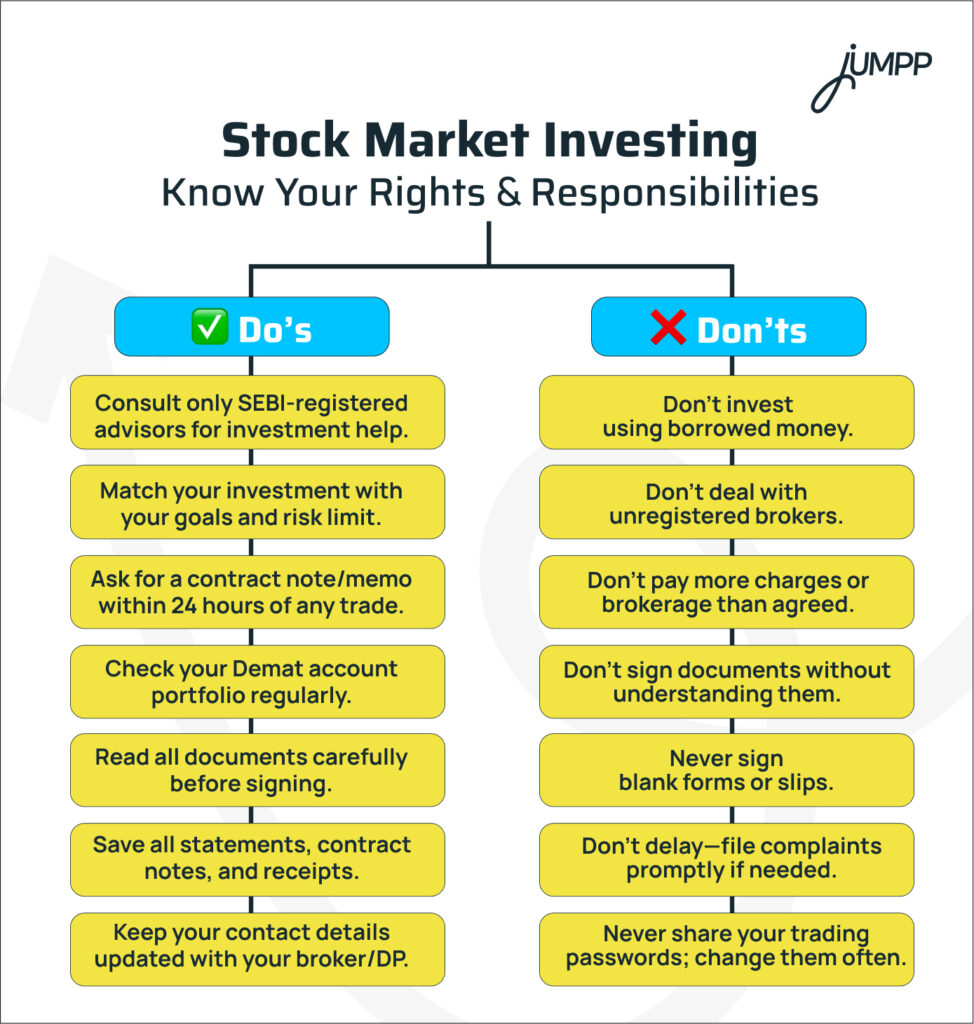
Stock Market Investing: Know Your Rights & Responsibilities
From stocks to SIPs, ETFs to Mutual Funds, it’s all here.
Invest smarter and faster with jUMPP!
Conclusion
Investing in the share market becomes far simpler once you understand the basics, follow a structured approach, and stay disciplined. Start small, research well, and focus on long-term growth instead of short-term noise. With the right strategy and consistent learning, any beginner can build confidence and gradually create wealth through the stock market.
Disclaimer: The information provided above is for educational purposes only and should not be considered investment advice or stock recommendations. Stock markets carry risk, and decisions should be made based on your own research or after consulting a SEBI-registered financial advisor.
How to Invest in Share Market: FAQs
To invest in the share market, you need a Demat and trading account. Once you have these, you can buy and sell shares through stock exchanges like NSE or BSE.
Beginners start by opening a Demat account and learning about shares. They usually begin with small investments to understand the market.
The best time depends on market conditions and your goals. Many investors watch price trends and company news before making decisions.
Beginners often focus on learning the basics, researching companies, and avoiding quick decisions based on rumours.
Beginners invest by buying shares of companies through a broker. They can track their investment using their Demat account.
Investors buy or sell stocks based on their financial goals, market trends, and company performance, but timing can vary widely.
New investors usually learn the stock market basics, research well, avoid rumours, and keep track of their investments regularly.
You’ll need a PAN card, an Aadhaar, a bank account, and proof of address to open a Demat and trading account.